PRINT PLAYBOOK GUIDE - PRODUCTION GUIDES
Part of Series: Production Guides
How Quantity and Print Run Length Affect Unit Cost
 ND4C Print Experts

Quick Answer: Why Does Printing Cost Less Per Piece at Higher Quantities?
Printing more pieces often lowers the unit cost because fixed production expenses, such as setup, file preparation, and equipment make-ready, are distributed across a larger quantity. Although material consumption and production expenses generally increase with volume, those additional costs may grow more slowly than the number of finished pieces.
A lower cost per piece does not always mean a lower total cost or a better purchasing decision. The best print quantity balances unit price, actual demand, waste, storage, and the likelihood that printed information will become outdated.
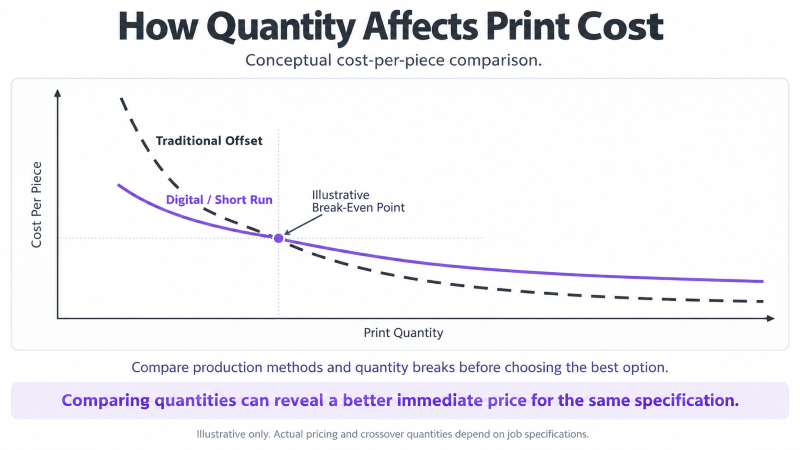
What Is Print Unit Cost?
30-Word Definition
Print unit cost is the average production cost per finished piece, calculated by dividing the total cost of a print run by the number of usable pieces produced.
Every print job contains fixed and variable costs. Fixed expenses can include prepress preparation, equipment setup, and other activities performed regardless of quantity. Variable expenses include materials, printing, and finishing operations that change with production volume.
As quantity increases, fixed costs can be spread across more pieces. Production efficiency, printing method, sheet utilization, and quantity breaks can further influence unit cost. Understanding these relationships helps print resellers compare quotes, protect margins, and avoid unnecessary inventory.
How Printing Quantity Affects Unit Cost
1. Fixed costs are distributed across the print run
Fixed costs do not change significantly with quantity within a particular production setup. Examples include prepress, equipment setup and make-ready, printing plates when applicable, initial calibration, and setup for cutting or folding. On a short run, these costs represent more of each piece's cost. When the same setup supports more pieces, the cost allocated per piece decreases.
2. Variable costs increase as more pieces are produced
Variable costs include paper or substrates, ink or toner, press time, finishing, packaging, and volume-related spoilage. They do not necessarily increase perfectly in proportion to quantity: purchasing terms, equipment speed, and workflow efficiency may change.
3. Longer runs may improve production efficiency
After initial setup, additional pieces may require relatively little preparation. Longer runs can improve equipment utilization, but additional batches, shifts, material changes, or capacity constraints may add costs.
4. Quantity breaks reflect changes in production economics
A quantity break is an order quantity at which quoted per-piece pricing changes. Breaks may reflect setup-cost distribution, production efficiency, or the printer's established pricing tiers. They do not always indicate a physical change in the production process.
Why are small runs often more expensive per piece?
Setup and preparation costs are divided among fewer pieces. Digital and shared-production workflows can help make shorter quantities economical.
How to Calculate Print Unit Cost
Basic unit-cost formula
Unit cost = Total production cost ÷ Usable finished quantity
Simplified model: Unit cost = (F + v × Q) ÷ Q = F ÷ Q + v
F = fixed production cost; v = variable cost per usable finished piece; Q = finished quantity. This model assumes constant variable costs and no additional setup thresholds.
Example: Spreading fixed costs over more pieces
Assume a hypothetical job has $60 in fixed production expenses and a variable cost of $0.08 per finished piece, with unchanged specifications and no additional setup charges.
| Quantity | Total production cost | Cost per piece |
|---|---|---|
| 100 | $68.00 | $0.680 |
| 250 | $80.00 | $0.320 |
| 500 | $100.00 | $0.200 |
| 1,000 | $140.00 | $0.140 |
| 2,500 | $260.00 | $0.104 |

Illustrative manufacturing economics only. These values are not ND4C prices or quotes.
In this model, fixed-cost savings are most noticeable at lower quantities. As the quantity grows, variable production costs account for a greater share of unit cost. Actual print prices may change in steps rather than following this smooth curve.
What Determines the Cost of a Print Run
Quantity is important, but it interacts with specifications and the production workflow.
| Cost factor | Effect on unit cost |
|---|---|
| Setup and make-ready | Usually a smaller share per piece at higher quantities |
| Printing method | Different setup and running-cost structures |
| Paper or substrate | Material consumption, yield, compatibility, and waste |
| Finished size and sheet utilization | Number of pieces per sheet and trimming waste |
| Ink and color | May change setup and production expenses |
| Finishing | Cutting, folding, coating, binding, and their setup requirements |
| Run length | Press time, productivity, and batch requirements |
| Waste and spoilage | More input material may be required to deliver usable pieces |
| Turnaround and shipping | Can alter scheduling, fulfillment, and delivered cost |
How sheet utilization affects unit cost
Multiple pieces are commonly arranged on a larger production sheet. A layout producing eight pieces per sheet uses material differently from a layout producing six. Actual yield depends on bleed, trim, equipment allowances, and finishing. Standard sizes can improve sheet efficiency; a custom size may produce additional waste or require a separate production run. See How Paper Size Affects Print Cost.
How finishing changes the equation
Folding, cutting, coating, or binding may require their own setup and per-piece processing. An unfolded flyer and a multi-panel brochure can therefore have different cost curves even at the same quantity. Compare like-for-like specifications when evaluating quantity alone.
How Digital and Offset Printing Economics Differ by Run Length
Digital printing generally involves less physical setup, while offset printing may involve greater upfront preparation and lower running costs at suitable volumes. Neither method is universally cheaper.
| Factor | Digital printing | Offset printing |
|---|---|---|
| Initial setup | Generally lower | Generally higher |
| Small quantities | Often advantageous | Setup may weigh heavily |
| Longer runs | Can remain competitive | Often benefits from volume |
| Additional pieces | Running cost may remain fairly consistent | Can have favorable per-piece economics after setup |
| Variable data | Suited to individualized content | Typically less suited to piece-by-piece changes |
| Crossover quantity | Job-specific | Job-specific |
Is there a quantity where offset becomes cheaper?
No universal crossover exists. A simplified break-even model is Q* = (Fixed offset cost − Fixed digital cost) ÷ (Digital variable cost − Offset variable cost), when offset setup costs are higher and digital variable costs are higher. Actual costs are not necessarily linear and may change across production tiers. See Digital vs Offset Printing for the full method comparison.
Print Quantity Versus Print Run Length
Print quantity refers to the number of finished pieces ordered or delivered. Print run length refers to output produced during a production run, often measured in sheets, impressions, or pieces depending on the operation.
A 4,000-piece job imposed eight-up requires at least 500 successfully printed sheets before accounting for make-ready or spoilage: 4,000 ÷ 8 = 500 sheets. A job may also be split across production batches. Production output, not just the finished order quantity, influences expenses.
How Waste Affects Unit Cost
Waste reduces the share of materials and production output that becomes usable finished product. Common sources include make-ready sheets, trimming, inefficient layouts, printing defects, finishing spoilage, and substrate defects.
Setup waste occurs before acceptable output begins and can weigh heavily on short jobs. Running waste occurs during production and may grow with volume.
How gang-run printing changes economics
Gang-run printing places compatible orders together on shared sheets, spreading certain preparation and material costs across jobs. ND4C uses gang-run production for standard catalog jobs. Custom sizes or unusual materials may not fit the established configuration and can require custom pricing. For details, see Gang Run Printing Explained.
Does printing more always reduce waste?
No. Larger runs may distribute fixed setup waste more efficiently, but total spoilage and unnecessary inventory can still increase.
When Ordering More Stops Producing Meaningful Savings
The benefit often diminishes after fixed costs become a small portion of unit cost. Actual prices can change irregularly because of quantity breaks, press constraints, production batches, or gang-run opportunities.
Look at incremental cost
Incremental cost per additional piece = (New total quote − Original total quote) ÷ Additional pieces
Consider these hypothetical quotes for an otherwise identical finished job:
| Quantity | Total price | Average price per piece |
|---|---|---|
| 500 | $120 | $0.240 |
| 1,000 | $170 | $0.170 |
| 2,000 | $270 | $0.135 |
Moving from 500 to 1,000 costs an additional $50 for 500 pieces, or $0.10 per extra piece. Moving from 1,000 to 2,000 costs $100 more for 1,000 extra pieces, also $0.10 each. The additional pieces may be inexpensive, but the overall order still costs more.
Is the lowest unit price always best?
No. Extra inventory can create storage expenses or become outdated before use. Judge savings against expected demand and content lifespan.
How to Choose the Most Economical Print Quantity
The most economical order is not necessarily the one with the lowest average unit price. Work through the following decision path before quoting.
Print Quantity Decision Path
1. Establish likely demand. How many finished pieces will the customer realistically use?
↓
2. Evaluate content lifespan. If details may change, favor shorter runs; if content is stable, evaluate larger tiers.
↓
3. Compare actual quotes. Review total cost, unit cost, incremental cost, turnaround, and identical specifications.
↓
4. Select the lowest practical cost for inventory likely to be used. Include storage, reordering, and obsolescence risk.
Favor shorter runs when
- Information changes often or demand is uncertain.
- A campaign or design is being tested.
- Storage space or working capital is limited.
- Version changes or frequent updates are likely.
Compare larger runs when
- Content is stable and consumption is predictable.
- The full quantity can reasonably be used.
- Storage is manageable and quantity breaks offer meaningful savings.
- Reordering would add significant setup or fulfillment cost.
Consider staggered reorders
Periodic smaller orders can limit obsolete stock but may incur repeated setup, shipping, or handling. Current pricing must be checked each time.
How ND4C Customers Can Compare Quantity Options
ND4C production and ordering experience
ND4C's wholesale ordering system lets customers compare available quantities, prices, and quantity breaks for standard catalog jobs. Where both are applicable, customers can compare Short Run and Regular pricing to determine the best immediate option.
- Compare practical order quantities: evaluate both total price and per-piece cost.
- Compare Short Run with Regular: neither is automatically the best option for every job.
- Keep specifications consistent: size, stock, coating, and finishing must match for meaningful quantity comparisons.
- Check current reorder pricing: ND4C reorders are priced at current prices, not guaranteed historical rates.
- Request custom estimates when needed: jobs outside catalog specifications require custom quoting, and custom jobs need a new quote for subsequent orders.
ND4C pricing does not change frequently, but customers should not assume earlier prices remain valid. For a broader explanation, see What Determines Wholesale Print Pricing?
Common Mistakes When Comparing Print Quantities
Mistake 1: Choosing the lowest unit price without estimating demand
Why it matters: Unused inventory increases the effective cost of pieces that are actually used. Better approach: Estimate realistic consumption and compare total spending.
Mistake 2: Assuming quantity alone determines price
Why it matters: Size, stock, finishing, waste, and method can change economics. Better approach: Keep specifications identical when comparing quantities.
Mistake 3: Ignoring quantity breaks
Why it matters: Nearby standard quantities can have better pricing. Better approach: Review all available tiers before quoting.
Mistake 4: Assuming offset always wins at volume
Why it matters: Break-even quantities depend on the actual job. Better approach: Compare finished digital and offset quotes.
Mistake 5: Overordering time-sensitive materials
Why it matters: Offers and contact information can become obsolete. Better approach: Choose shorter runs if updates are probable.
Mistake 6: Treating prior prices as permanent
Why it matters: Reorder and production pricing may change. Better approach: Obtain a current quote.
Production Quantity Checklist
Before You Order
- ☐ Determine realistic finished quantity and expected usage.
- ☐ Confirm how long the design and information will remain accurate.
- ☐ Verify size, stock, color, and finishing.
- ☐ Compare available quantity breaks.
- ☐ Compare Short Run and Regular where applicable.
- ☐ Evaluate total price, unit price, and incremental cost.
- ☐ Consider storage, waste, and inventory obsolescence.
- ☐ Confirm turnaround and shipping requirements.
- ☐ Request a custom estimate if specs fall outside catalog options.
- ☐ Use current pricing rather than a previous order price.
Common Questions About Print Quantity and Unit Cost
1. Why does printing more pieces usually reduce cost per piece?
Fixed expenses are spread across more finished pieces. Greater production efficiency and quantity tiers can also help.
2. Is there a minimum quantity for a good price?
No universal minimum exists. Compare actual pricing for the intended specifications.
3. What is a quantity break?
It is a tier where the quoted per-piece price changes with order quantity.
4. Does doubling quantity cut unit cost in half?
Usually not. Material and other variable expenses generally rise with quantity.
5. Can printing too many pieces raise costs?
Yes. Larger orders raise total spending and may create unused or outdated stock.
6. Why do printers quote different prices for the same quantity?
Equipment, workflow, sheet yield, and purchasing arrangements can differ.
7. Is digital always cheaper for a short run?
No. It often has favorable setup economics, but final prices depend on the job.
8. At what volume does offset become cheaper?
There is no universal threshold. Compare quotes for the actual specifications.
9. How does gang running affect small-job costs?
Compatible orders can share production sheets and certain setup resources.
10. Does a larger quantity always take longer?
No. Scheduling, production method, equipment, and finishing determine actual timing.
11. Should a customer order extra pieces to avoid reprints?
Only when extra pieces are likely to be used before becoming obsolete.
12. How should resellers compare quantities?
Compare total price, unit price, incremental cost, demand, and inventory risk.
13. Will a repeat order cost the same as the original?
Not necessarily. ND4C reorders use current pricing and custom jobs require requoting.
14. Is production unit cost the same as the reseller selling price?
No. Resale pricing may include services, overhead, shipping, and margin.
Key Takeaways
- Fixed setup costs are spread over more pieces at higher quantities.
- Variable costs still increase with materials, press time, finishing, and waste.
- Quantity breaks should be evaluated with actual quotes.
- The lowest unit cost may not be the lowest practical purchasing cost.
- Compare identical specifications to isolate the quantity effect.
- Reorders should always use current wholesale pricing.
Related Production Guides
- Digital vs Offset Printing: Compare how setup and running costs influence method selection.
- Short Run Printing Explained: Decide when smaller orders justify potentially higher per-piece pricing.
- What Determines Wholesale Print Pricing?: Understand other variables behind wholesale quotes.
- How Paper Size Affects Print Cost: See how finished dimensions and sheet yield affect cost.
- How to Reduce Print Production Costs: Explore practical specification and ordering choices.
Related Products and Applications
Quantity economics apply across most wholesale products, with different demand and obsolescence considerations.
| Product | Quantity consideration |
|---|---|
| Business cards | Likely distribution and changing contact details |
| Postcards | Mailing list size and campaign demand |
| Flyers | Event timing and distribution capacity |
| Brochures | Potential changes to product or service information |
| Repeat-order marketing pieces | Larger single orders versus smaller periodic reorders |
Final Next Step
Before committing to a print quantity, compare at least two practical order sizes using current wholesale prices. Evaluate total spending, unit cost, and whether the pieces will be used.
For qualifying standard products, compare quantity breaks and applicable Short Run versus Regular options at ND4C.com.
ND4C is a wholesale trade printer with more than two decades of industry experience. Our Print Playbook guides draw on firsthand expertise across prepress, production, customer support, design, and print technology to help retail printers and print resellers make better production decisions.