PRINT PLAYBOOK GUIDE - PRODUCTION GUIDES
Part of Series: Production Guides
Gang Run Printing Explained
 ND4C Print Experts
Quick Answer: What Is Gang Run Printing?
Gang run printing is a production method that combines multiple independent print jobs onto the same press sheet so they can be printed together. By sharing press setup, materials, and production resources, printers can reduce the cost of producing individual orders.
Gang running is widely used in wholesale printing for standardized products such as business cards, postcards, and flyers. It is particularly effective when jobs share compatible paper stocks, color requirements, and finishing specifications.
The main tradeoff is reduced flexibility. Because multiple jobs share a production run, individual orders may have less control over color adjustments, scheduling, and custom specifications than they would on a dedicated press run.
What Is Gang Run Printing?
30-Word Definition
Gang run printing combines multiple independent print jobs on shared press sheets, reducing setup costs, improving material utilization, and making standardized print products more economical to produce in quantity.
Key Takeaways
- Gang running combines independent jobs on shared press sheets to distribute production costs.
- Standardized specifications help printers group jobs efficiently and improve sheet utilization.
- Gang running is especially useful for common commercial print products, but it is not always the lowest-cost production option.
- Shared press conditions can limit job-specific color adjustments and affect repeatability.
- Custom materials, tight color requirements, and unusual specifications may justify alternative production arrangements.
- Gang running describes production grouping, while offset and digital printing describe printing technologies.
Why gang running matters in wholesale printing
Traditional offset printing involves setup work before production begins. When a single small order carries the full cost of preparing the press, producing that order independently can be expensive.
Gang running distributes eligible setup and production costs across multiple orders. A wholesale printer can arrange artwork from different customers on a common sheet, print the sheet as one production run, and separate the individual orders during finishing.
This helps make commercial offset production economically practical for standardized products ordered in modest quantities.
However, the jobs must be compatible with the shared production specifications. Gang running is a method of organizing production, not a separate printing technology.
How Does Gang Run Printing Work?
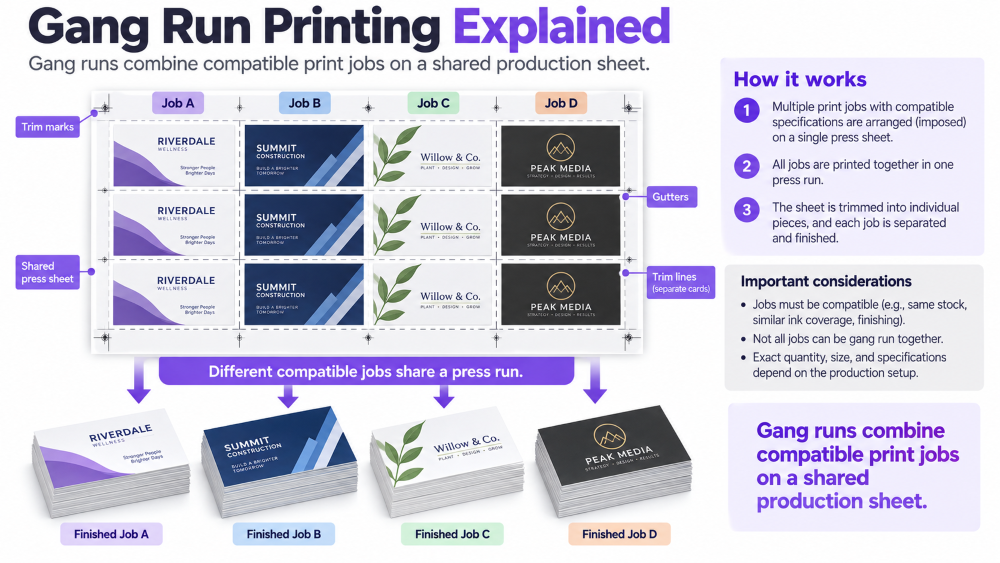
A gang run typically involves five production stages.
- Collect compatible print jobs. Orders are grouped according to production requirements such as paper stock, ink configuration, coating, and suitable finishing processes. Different designs and customers may share the same run.
- Arrange artwork on a press sheet. Prepress software or production planning determines how individual jobs fit together on a larger sheet. This arrangement is called imposition. Each job requires appropriate spacing and allowances for trimming and other finishing operations.
- Print the combined sheet. The imposed artwork is produced during a common press run. In conventional offset gang printing, compatible jobs share press setup and printing plates. The sheet is printed as a coordinated production unit rather than as separate customer orders.
- Finish and separate the jobs. Printed sheets proceed through required operations such as coating, cutting, or other finishing. Individual products are separated according to their specifications.
- Sort and fulfill individual orders. Finished products are counted, organized, packaged, and delivered according to each customer's order. Sharing a press sheet does not mean customers receive one another's products.
Example: Multiple business card orders on one sheet
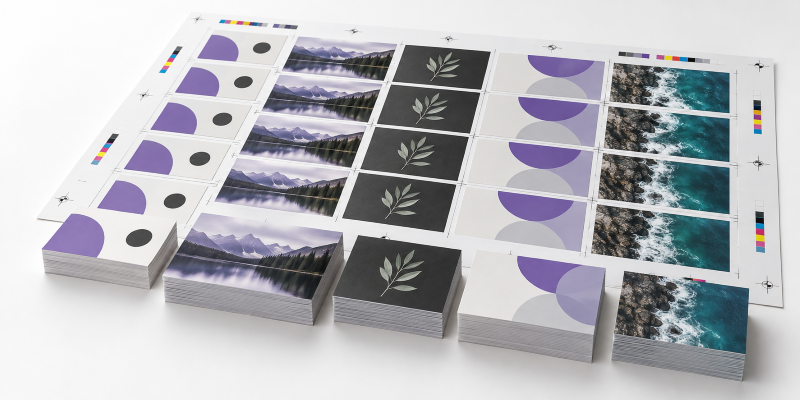
Twelve independent card designs could be arranged on one illustrative shared press sheet. Actual layouts depend on press dimensions, artwork, quantities, cutting allowances, and other production requirements.
The important distinction is that each business card design is a separate order, but the designs share one printing operation.
An individual job can also occupy multiple positions on a sheet when quantities or layout requirements call for it. Gang imposition does not require every order to receive exactly one position.
Why Are Multiple Jobs Combined on One Press Sheet?
Printers combine jobs primarily to improve production efficiency and distribute fixed costs.
1. Shared setup costs
Offset production requires preparing printing plates, configuring the press, and bringing the machine into a usable printing condition.
When compatible orders share this setup, individual jobs do not need separate press makereadies.
2. Better sheet utilization
Placing multiple orders together can fill unused areas of a larger sheet.
Better utilization may reduce the number of sheets needed to produce a group of orders and reduce the amount of unused paper.
However, optimal layouts must still account for sheet grippers, registration, trimming allowances, and finishing.
3. Consolidated production
Similar jobs can move through printing and compatible finishing operations together.
This may reduce repeated setups and unnecessary production handling compared with running each job separately.
4. Lower cost per order
Shared expenses can make the allocated cost of producing each order lower than if that order required an independent setup.
Production implication: Gang running is especially valuable when many customers order standardized products using compatible specifications. That is one reason it fits the wholesale printing business model. ND4C uses gang-run printing, although individual product workflows should not be assumed without confirmation.
What Production Factors Affect Gang Run Efficiency?
| Production factor | Why it matters |
|---|---|
| Paper stock | Jobs generally must use the same stock specification to share a sheet. |
| Paper size | The relationship between finished dimensions and the parent sheet affects how efficiently orders fit together. |
| Color requirements | Compatible ink configurations can share production. Individually controlled colors may require another approach. |
| Order quantity | Quantities influence the number of sheets and positions needed for each job. |
| Coatings and finishes | Jobs must be compatible with the shared production and finishing workflow. |
| Press setup | Shared preparation can reduce the fixed cost allocated to individual orders. |
| Scheduling | Orders must fit an available production grouping and its schedule. |
| Cutting and finishing | Layouts must support reliable separation and any additional product-specific operations. |
Why do standard sizes improve efficiency?
Standard sizes are easier to combine because their dimensions can be planned around repeatable press layouts.
For example, commonly ordered business card or postcard sizes may fit established imposition arrangements. Unusual finished dimensions can leave more unused sheet area or require additional cutting considerations.
This does not mean a custom size cannot be gang run. It means the cost advantage depends on whether that size fits efficiently into a compatible production grouping.
For the broader relationship between finished dimensions, parent sheets, and paper yield, see How Paper Size Affects Print Cost.
Do all gang-run jobs have to use identical quantities?
No. Different quantities can sometimes share a gang run.
The printer may allocate more positions to one design, use different sheet groupings, or schedule production according to the quantity requirements of participating orders.
The limitation is that quantity differences can make imposition less efficient. A job with unusual quantity requirements may not fit a standard production arrangement economically.
How Does Gang Run Printing Reduce Cost?
Gang run printing reduces cost by distributing eligible setup and press expenses across multiple jobs and using printing materials more efficiently. Its greatest economic advantage typically comes from avoiding separate setups for many small, compatible orders.
The savings are not simply the result of placing more artwork on a sheet. They come from the relationship between shared production expenses and the number of individual jobs produced.
Where the savings occur
| Cost component | Gang-run impact |
|---|---|
| Prepress and imposition | Combined planning may improve efficiency, although each file still requires appropriate preparation. |
| Plates and press setup | Compatible offset jobs can share setup expenses. |
| Paper | Improved sheet utilization can reduce waste. |
| Press operation | Multiple orders can be produced during a common press run. |
| Finishing | Compatible operations may be consolidated; unique finishes can increase handling. |
| Unit cost | Lower allocated production expenses can reduce the cost per finished piece. |
| Shipping | Separate packaging and delivery costs still apply; gang running does not automatically reduce them. |
Illustrative cost example
Suppose four independent orders require the same stock, process-color configuration, and compatible finishing.
If each order needs a separate press setup, the printer performs that setup four times.
If all four orders can share one properly planned run, the setup expense can be distributed across the four orders.
Separate runs: Job 1 setup + Job 2 setup + Job 3 setup + Job 4 setup = four press setups.
Combined gang run: Four orders printed with one shared press setup.
The example illustrates setup sharing, not an exact price reduction. Total savings depend on run length, press configuration, sheet yield, paper cost, finishing, spoilage, and production planning.
Is gang running always the cheapest option?
No.
Gang running is often economical for standardized orders, but a dedicated offset run, a digital run, or another production arrangement may cost less for a particular job.
For example, a very small variable-data order might be more economical digitally, while a large uniform order could justify its own dedicated press run.
The correct comparison is the total production cost for the required specifications, not simply whether an order can be gang run.
For a broader breakdown, see What Determines Wholesale Print Pricing?
What Are the Advantages and Limitations of Gang Run Printing?
| Advantages | Limitations |
|---|---|
| Shares setup costs across multiple orders | Less opportunity for job-specific press adjustments |
| Can improve paper utilization | Jobs must use compatible materials and production specifications |
| Makes standardized products more economical | Unusual sizes or finishes may be less efficient |
| Can consolidate production workflows | Scheduling depends on available production groupings |
| Supports consistent, repeatable product offerings | Exact color matching may be harder to control |
| Allows modest quantities to benefit from shared offset production | Repeat orders may not reproduce identically across different runs |
The key distinction is production efficiency versus individual control.
A gang run can produce high-quality commercial printing. Its limitation is not that shared production is inherently poor quality, but that one customer's job does not independently determine every press adjustment or production parameter.
How Does Gang Run Printing Affect Color Consistency?
Color consistency is one of the most important considerations when deciding whether to use gang-run production.
On an offset gang run, several designs share the same press sheet and ink configuration. Press adjustments therefore affect multiple jobs, rather than one individual design.
The printer must manage color for the combined sheet. Adjusting press conditions specifically to improve one job may affect other work produced at the same time.
What color differences should a reseller expect?
Color differences can occur between a gang-run product and:
- A customer's computer display
- A previous printing of the same artwork
- Another product printed using a different process or stock
- A specific brand-color reference
- A sample printed during a different production run
Some of these differences occur in all printing methods, not just gang runs. Paper color, coatings, ink behavior, viewing conditions, and color-management practices also affect reproduction.
However, gang running introduces an additional constraint because the press setup is shared. The surrounding mix of artwork and press conditions may change between production runs.
Is gang run printing suitable for color-critical projects?
Gang running may be unsuitable when a customer requires a tightly controlled match to a brand standard, approved physical sample, or previous production run.
A dedicated printing arrangement can provide more opportunity for job-specific adjustments and approved color-control procedures.
That does not guarantee perfect reproduction. It gives the printer more individual control over the job.
Production decision: If an acceptable color difference cannot be determined before production, discuss the requirement with the printer and obtain a suitable custom estimate or production recommendation.
For the differences between process-color reproduction and individually specified inks, see Spot Color vs CMYK.
Gang Run vs Dedicated Printing
A dedicated run reserves its press setup and production arrangement for a particular job or coordinated group of work.
Gang running shares the setup across independently ordered jobs.
| Factor | Gang run | Dedicated run |
|---|---|---|
| Press setup | Shared among jobs | Assigned to the specific run |
| Typical advantage | Lower allocated cost for compatible orders | Greater control and customization |
| Paper stock | Usually selected from compatible shared options | More flexibility to specify stock |
| Size | Standardized sizes often fit best | Custom dimensions may be easier to accommodate |
| Color control | Adjustments managed across the shared sheet | Greater opportunity for job-specific control |
| Finishing | Must fit the compatible production workflow | More flexibility for specialized finishing |
| Quantity | Useful for many modest, standardized orders | Often attractive for high quantities or specific requirements |
| Scheduling | May depend on the available gang schedule | Can be planned around an individual run, subject to capacity |
| Reorders | May share a different mix of jobs | More control over reproducing a defined specification |
| Cost | Can distribute fixed costs | Carries its own setup costs |
Neither method is automatically superior. The choice depends on the specifications that must be controlled and the economics of producing the order.
Can digital printing also combine jobs?
Yes. Digital workflows can impose multiple designs on a shared sheet, sometimes called digital ganging.
However, digital printing generally does not require the offset printing plates and corresponding makeready process that create a major incentive for traditional offset gang runs.
In digital production, combining jobs can still improve sheet utilization, finishing efficiency, and workflow organization.
Gang running describes how jobs are grouped. Digital and offset describe how the image is produced.
How to Decide Whether Gang Run Printing Is Appropriate
Use the following decision framework before quoting or outsourcing a print job.
| If the job requires… | Investigate… |
|---|---|
| Standard-size, full-color marketing pieces at a competitive price | Gang-run production |
| A tight match to a specific brand color | Dedicated production with appropriate color controls or spot-color options |
| Custom stock, unusual dimensions, or specialized finishing | Custom or dedicated production |
| High quantities of one identical design | Dedicated offset production alongside available gang-run pricing |
| Very small quantities or variable data | Digital printing |
| A specific delivery date | Confirmed production and shipping schedules |
| Repeat orders that must match a physical reference closely | A controlled, documented production approach |
A practical decision sequence
- Confirm the product specifications. Identify size, stock, color requirements, finishing, and quantity.
- Identify any critical requirements. Determine whether color, dimensional accuracy, or a particular substrate requires additional control.
- Check standard production options. See whether compatible gang-run products meet the actual job requirements.
- Compare production economics. Evaluate gang-run, digital, or dedicated production when more than one is viable.
- Verify turnaround and delivery. Confirm whether the chosen production arrangement meets the required date.
Do not assume that ordering a standard product guarantees it is gang run, or that selecting a custom estimate automatically means dedicated production. The supplier's actual production approach must be confirmed when it matters.
Common Gang Run Printing Mistakes
1. Assuming a reorder will match the previous run exactly
Why it matters: A reorder may be printed with different neighboring jobs and production conditions. Some color variation may occur.
Better approach: Determine the customer's acceptable color variation before ordering. For tightly controlled reorders, discuss a documented color target and appropriate production method.
2. Selecting standard pricing for a color-critical project
Why it matters: Standard shared production may not provide the individualized press adjustments needed to meet a narrowly defined color target.
Better approach: Identify color-critical requirements before quoting and request an appropriate production recommendation.
3. Assuming every custom size will fit efficiently
Why it matters: An unusual finished size can reduce sheet utilization or require additional finishing.
Better approach: Compare standard dimensions with the requested custom size before selecting the production arrangement.
4. Overlooking stock or finishing compatibility
Why it matters: Jobs with different materials or incompatible processes may not be able to share the same production setup.
Better approach: Confirm all specifications instead of assuming the same product category means the same production workflow.
5. Confusing gang running with inferior printing
Why it matters: Gang running is a production-planning technique. A correctly managed gang run can produce professional commercial print quality.
Better approach: Evaluate the supplier's documented specifications and the customer's actual quality requirements rather than judging the method by price alone.
6. Assuming sharing a sheet guarantees faster turnaround
Why it matters: A job may need to wait for a compatible production grouping. Processing and finishing schedules can also affect completion.
Better approach: Verify the published production turnaround and applicable order cutoffs before making a delivery commitment.
7. Ignoring file setup and trimming requirements
Why it matters: Shared-sheet production still requires correctly prepared artwork. Missing bleed, incorrect finished dimensions, and text placed too close to trim can cause problems.
Better approach: Confirm final size, bleed, safe area, and file requirements before submission.
ND4C production experience: Missing bleeds, incorrect final sizes, and text positioned too close to trim are common file problems ND4C encounters. These issues are relevant to many production methods, not uniquely gang running.
Production Checklist: Before Ordering a Gang-Run Candidate
- ☐ Finished size and quantity are confirmed
- ☐ Paper stock and coating meet customer requirements
- ☐ Color-critical elements and acceptable variation are identified
- ☐ Custom finishing or material requirements are disclosed
- ☐ Artwork has correct bleed, trim dimensions, and safe margins
- ☐ The proposed production method supports required specifications
- ☐ Quoted turnaround and shipping requirements are verified
- ☐ Customer expectations for reorders are established
Common Questions About Gang Run Printing
Is gang run printing the same as offset printing?
No. Gang running is a way of organizing multiple jobs into one production run. Offset printing is a printing process. Gang runs commonly use sheetfed offset equipment, but digital workflows can also combine different jobs on shared sheets.
Why is gang run printing generally less expensive?
Gang running can lower the cost allocated to each order by sharing setup, press operation, and paper across compatible jobs. Actual savings depend on quantities, materials, layouts, and finishing requirements.
Can different customers’ jobs be printed on the same sheet?
Yes. Multiple customers’ artwork can share one sheet when their jobs are compatible with the production plan. The finished pieces are separated and fulfilled as individual orders.
Is gang run printing lower quality than dedicated printing?
Not necessarily. Professional equipment and production controls can produce good-quality results using either approach. Gang running provides less opportunity for individual press adjustments, which can matter when strict color or other custom specifications are required.
Why can colors vary between gang-run reorders?
Different runs may contain different combinations of artwork and operate under different press conditions. Because color adjustments are managed across a shared sheet, the same design may not reproduce identically on every run. Substrate and other normal printing variables can also contribute.
Can gang run printing reproduce exact Pantone colors?
Standard process-color gang runs are generally not the preferred approach for an exact Pantone spot-color requirement. A spot-color-capable or otherwise controlled production option may be more suitable. Whether a particular color is available must be confirmed with the printer.
What products are commonly gang run?
Common examples include standard-size business cards, postcards, flyers, rack cards, and other standardized marketing materials. Availability depends on the supplier’s production systems, stock options, and finishing requirements.
Can different paper stocks share one gang run?
Not on the same physical press sheet. Jobs sharing one sheet use the same physical stock, although a printer may organize separate gang groups for different materials during its broader production schedule.
Can different quantities share a gang run?
Yes, when imposition and scheduling permit. The printer may assign different numbers of positions or organize the jobs into suitable production groups. Large quantity differences can reduce efficiency.
Does gang run printing take longer?
Not inherently. Gang running can be efficient, but production may depend on scheduled press runs or the availability of compatible jobs. Actual turnaround varies by supplier, product, finishing requirements, and production capacity.
Are custom sizes available with gang-run printing?
Sometimes. Custom dimensions can be included when they fit the press layout and finishing workflow efficiently. Unusual sizes may instead require a dedicated run or a custom estimate.
Is gang run printing suitable for high quantities?
It can be, but dedicated production may become more economical or provide better control as quantities increase. Both options should be compared for the actual job.
Can gang runs be used for variable-data printing?
Traditional offset gang runs are generally not used to produce individually changing information within a common printed image. Digital printing is typically better suited to variable names, addresses, numbers, and other personalized content.
Does gang running always reduce paper waste?
No. Efficient imposition can improve sheet utilization and reduce waste, but results depend on job dimensions, quantities, stock, cutting allowances, and layout. Some combinations offer greater savings than others.
How does gang running affect wholesale printing prices?
Gang running allows wholesale printers to distribute fixed production costs across compatible customer orders, supporting competitive pricing for standardized products. However, each supplier’s pricing also reflects materials, quantities, finishing, production capacity, and other expenses.
Related Production Guides
These guides expand on the production methods, cost factors, and color requirements that influence gang-run decisions.
- How Trade Printing Works. Understand how wholesale printers organize production and fulfill jobs for independent print resellers.
- What Determines Wholesale Print Pricing? Explore the broader factors behind wholesale pricing, including setup, quantity, materials, finishing, and production efficiency.
- How Paper Size Affects Print Cost. Understand how finished dimensions, parent-sheet sizes, and sheet utilization influence material costs and production efficiency.
- How to Reduce Print Production Costs. Identify practical ways to improve production economics through specification choices, planning, and appropriate production methods.
- Spot Color vs CMYK. Learn how color reproduction methods differ and when a job requires more specific color control than standard process-color production provides.
- Digital vs Offset Printing. Compare two major printing technologies and understand why their setup requirements, run lengths, and production economics differ.
Related Products and Applications
Gang-run production concepts are particularly relevant to common, standardized commercial print products.
| Product or application | Gang-run relevance |
|---|---|
| Business cards | Standard sizes and commonly used stocks make multiple customer orders practical candidates for shared production. |
| Postcards | Repeatable dimensions and compatible full-color specifications can support efficient layouts. |
| Flyers | Standard paper sizes and common stock selections can simplify production grouping. |
| Rack cards | Consistent dimensions and material choices may allow economical shared-sheet production. |
| Standardized marketing pieces | Products with repeatable specifications can benefit from shared setup and efficient imposition. |
These examples illustrate typical industry applications. They do not establish which products ND4C specifically produces using gang-run methods.
Explore the corresponding products in the ND4C wholesale printing catalog to review available specifications and ordering options.
Final Next Step
Before quoting a standardized print job, confirm the required size, quantity, stock, finishing, and color expectations.
Compare available standard production options with custom or dedicated production when requirements justify additional control. Evaluate the complete job specifications rather than assuming the least expensive production method is appropriate.
ND4C is a wholesale trade printer with more than two decades of industry experience. Our Print Playbook guides draw on firsthand expertise across prepress, production, customer support, design, and print technology to help retail printers and print resellers make better production decisions.