PRINT PLAYBOOK GUIDE - PRODUCTION GUIDES
Part of Series: Production Guides
How Paper Size Affects Print Cost
 ND4C Print Experts
Quick Answer: How Does Paper Size Affect the Cost of a Print Job?
Paper size affects printing cost by determining how efficiently finished pieces fit onto larger printing sheets, how much material is wasted, and whether the job fits an established production workflow. Standard finished sizes are often more economical because printers can group compatible jobs together, reduce setup costs, and maximize sheet utilization.
Custom sizes may require separate production or less efficient layouts, increasing cost. However, when a project requires precise dimensions, custom printing may be the appropriate solution despite the higher price.
What Is Sheet Utilization in Printing?
30-Word Definition
Sheet utilization measures how efficiently a printing sheet is used to produce finished pieces. It depends on finished dimensions, layout, bleed, cutting allowances, and the printer’s available production equipment.
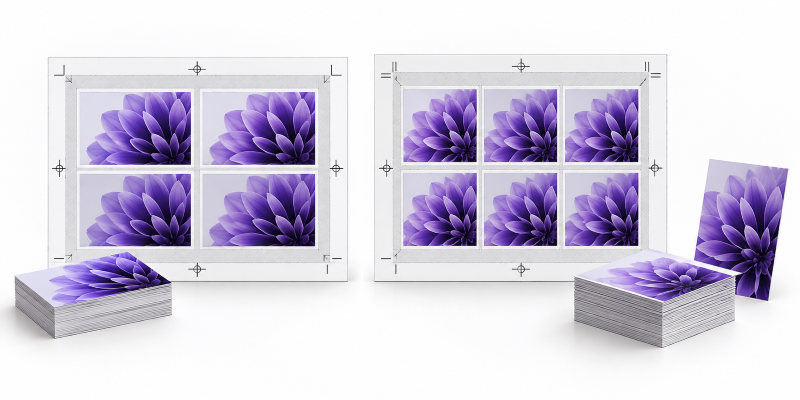
Commercial printers commonly produce multiple items on a larger sheet rather than printing each piece individually. The arrangement of those items, called imposition, determines how many finished pieces can be produced from each sheet.
A finished size that fits efficiently into a particular sheet layout can reduce paper consumption. Another size, even one with similar dimensions, may leave more unusable space or require additional sheets.
In wholesale printing, sheet utilization can also depend on whether multiple compatible customer orders can be grouped into the same production run. This practice, called gang-run printing, helps distribute production costs across multiple jobs. The advantage depends not only on individual dimensions but also on compatibility with the printer’s production system.
How Does Paper Size Affect the Printing Process?
Finished size influences printing long before a job reaches the cutting equipment. In sheetfed production, the printer determines how the pieces fit onto a larger sheet supported by the equipment.
From finished size to completed print job
- Establish the finished size. Confirm final width and height after trimming, folding, or binding; distinguish folded size from flat production size.
- Identify a suitable production sheet. Evaluate stock, printable area, equipment, and job requirements.
- Plan the imposition. Arrange pieces with correct orientation, bleed, margins, and spacing.
- Determine sheet yield. Calculate how many pieces can be produced from each sheet.
- Evaluate production grouping. Determine whether compatible orders can share a run or need separate production.
- Print and finish. Print, cut, fold, bind, or otherwise finish the order.
Why a small size change can make a difference
These two hypothetical layouts illustrate why similarly sized pieces may have different sheet yields. They do not represent actual ND4C production sheets or imposition patterns.
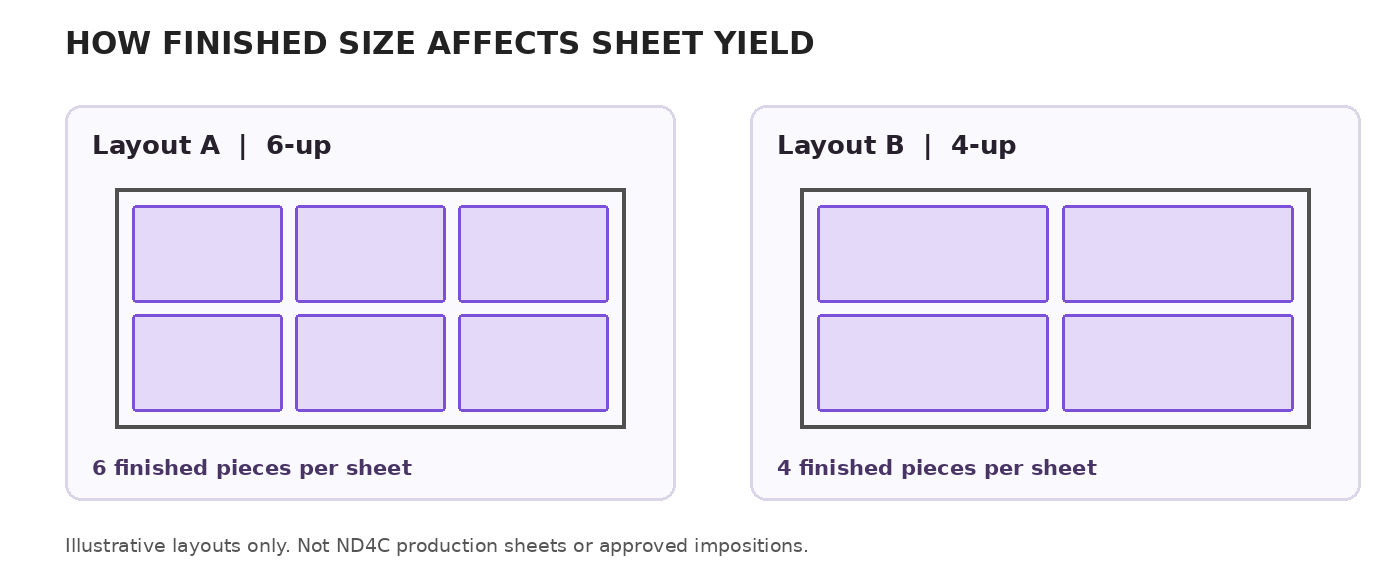
| Comparison | Layout A | Layout B |
|---|---|---|
| Pieces per sheet | 6 | 4 |
| Finished quantity | 1,200 | 1,200 |
| Theoretical minimum sheets | 200 | 300 |
Layout B needs 50% more sheets for the same finished quantity in this simplified example. That does not mean the completed job costs 50% more: stock, printing method, setup, spoilage, finishing, and other costs also matter.
Gang-run context
In a gang-run environment, multiple compatible orders may share sheets and setup expenses. Individual sheet yield is useful for learning the principle, but it is not a substitute for an actual production quote.
What Factors Determine Whether a Paper Size Is Economical?
Finished dimensions
Width, height, proportions, and orientation determine how a piece can be arranged. Two similarly sized pieces may have different sheet yields.
Parent sheet dimensions
A parent sheet is a larger sheet of paper or substrate from which smaller sheets or finished pieces are produced. Its dimensions and the equipment’s printable area affect layout efficiency.
Bleed, margins, and cutting allowances
Full-bleed artwork extends beyond the trim line. Production margins and cutting allowances reduce the space available to finished pieces; calculations based on finished dimensions alone may overestimate yield.
Production grouping and gang runs
Compatible jobs can share a production run and distribute setup and other manufacturing costs. Finished size, stock, printing specifications, and production constraints all affect compatibility.
Orientation and paper grain
Rotating a piece can improve fit, but grain direction may restrict orientation when folding, scoring, or binding.
Stock availability
An efficient theoretical layout may not use a readily available or appropriate stock. Material sourcing and equipment compatibility influence actual economics.
Finishing requirements
Trimming, folding, scoring, binding, and specialty finishes can change when dimensions change. Better material yield does not guarantee lower finishing cost.
ND4C production insight
ND4C’s production grouping system is designed to maximize sheet efficiency while reducing waste and setup costs. Standard catalog products are structured to benefit from these efficiencies. A custom size that does not fit an established group may need to be produced separately.
How Does Paper Size Affect Printing Cost?
| Cost component | How finished size can affect it |
|---|---|
| Material cost | Potential sheet yield and paper consumption |
| Setup cost | Whether production setup can be shared in a gang run |
| Printing cost | Sheet or impression requirements |
| Finishing cost | Cutting, folding, binding, or specialty operations |
| Waste | Unused paper and production spoilage |
| Production efficiency | Compatibility with established workflows |
| Unit cost | Total job costs spread across finished quantity |
| Shipping cost | Package dimensions, weight, and handling |
Sheet yield formula
Theoretical minimum sheets
Minimum sheets = round up (Finished quantity ÷ Pieces per sheet)
Example: 1,200 pieces ÷ 6 per sheet = 200 minimum sheets.
This is a simplified material calculation; production often requires extra sheets for setup, testing, and spoilage.
Unit cost formula
Cost per finished piece
Unit cost = Total job cost ÷ Finished quantity
Improvements in layout may reduce certain costs, but unit cost depends on the complete production quote.
Why gang-run compatibility matters
A compatible standard job may share manufacturing expenses with other orders. A job requiring dedicated production may have to absorb more of its own setup and production costs. This is why even a slightly different custom size can have a materially different price.
Practical rule
Compare complete quoted job prices rather than estimating cost from finished dimensions or percentage of paper used.
Why Are Standard Print Sizes Often More Economical?
Standard sizes can support established production layouts, material handling, and finishing workflows. In wholesale production, a further advantage comes from grouping compatible orders together.
How ND4C’s standard sizes support lower pricing
ND4C’s standard catalog products are designed around gang-run production. Compatible orders can share production runs, improving sheet efficiency while reducing waste and setup expense. A custom-size job may not fit an established group and, in some cases, must be produced separately.
Price implication
For comparable ND4C jobs, standard catalog sizes offer better pricing than custom-size production. Custom production is still appropriate when precise dimensions are necessary.
| Consideration | Standard catalog size | Custom finished size |
|---|---|---|
| Production grouping | Designed for established gang-run workflows | May not fit available production groups |
| Setup | Benefits from shared setup | May need separate setup |
| Sheet utilization | Supported by optimized grouping | Depends on custom layout |
| Waste | Grouping aims to minimize waste | May be less efficient |
| Pricing | Lower for comparable ND4C standard jobs | Custom quote reflects actual requirements |
| Flexibility | Available catalog specifications | Precise nonstandard dimensions |
| Best use | An existing size meets the need | Exact dimensions are necessary |
When should a reseller choose a custom size?
Custom dimensions make sense for pieces that must fit a particular enclosure or display, match another component, or satisfy a precise customer specification. When a custom estimate is requested, ND4C may identify a comparable catalog size to verify that custom manufacturing is necessary. When precise dimensions remain essential, ND4C will quote the requested custom job.
Can Changing the Finished Size Reduce Print Cost?
Yes, when a change improves material usage or allows production through an established standard workflow. For gang-run printing, moving from a custom dimension to a suitable standard catalog size can offer advantages beyond paper consumption alone.
When an adjustment may help
- The revised size fits a standard gang-run configuration.
- The original dimensions require dedicated custom production.
- The adjustment allows more pieces per sheet.
- The revised size simplifies manufacturing or finishing without compromising the application.
When it may not help
- Both sizes remain outside the catalog.
- The revised size does not change the production arrangement.
- Stock, grain, folding, or binding constraints eliminate the anticipated advantage.
- The customer needs exact dimensions for the application.
Practical reseller example
A customer requests a postcard with unusual dimensions. Before arranging a custom estimate, the reseller checks whether a standard postcard size meets the application. If it does, the standard product can benefit from established gang-run pricing. If the customer needs precise dimensions, a custom quote establishes the appropriate price. This is a decision example, not a measured ND4C cost comparison.
How Does Finished Size Affect the Printing Method?
| Production method | Size considerations | When to investigate |
|---|---|---|
| Sheetfed digital | Supported sheet formats, printable area, and finishing | Compatible shorter or flexible runs |
| Sheetfed offset | Press-sheet formats, imposition, setup, and run requirements | When run requirements and economics support offset |
| Wide-format | Equipment width and media handling | Oversized products |
| Web or roll-fed | Web width, cutoffs, layout, and finishing | Compatible high-volume work |
These are general industry considerations, not statements about ND4C’s particular equipment. Size should be evaluated alongside quantity, stock, color, turnaround, and finishing. See How to Choose a Printing Method for the wider comparison.
How Does Paper Size Interact With Finishing?
Brochures and folded products
Folded size differs from flat production size. Panel widths, fold sequence, grain, and scoring can change which dimensions work efficiently.
Booklets
Page dimensions affect signatures, folding, binding, and trimming. Estimate the complete manufacturing sequence, not only the area of one page.
Cards and flat products
Business cards, postcards, and flyers often have simpler imposition, but cutting patterns, bleed, stock grain, and special finishes still matter.
Specialty finishing
Die cutting, foil, perforation, coatings, and other options may create additional layout constraints.
Advantages and Limitations of Optimizing Finished Size
| Advantages | Limitations |
|---|---|
| May improve sheet utilization | Savings depend on actual production workflows |
| May reduce material use | Small changes do not always affect yield |
| May support shared gang runs | Not every job fits grouped production |
| May lower setup or production costs | Customer requirements can prevent adjustments |
| Can avoid unnecessary custom pricing | Standard dimensions are not suitable for every application |
| May reduce avoidable waste | Finishing and material requirements can offset savings |
How to Choose a Cost-Effective Print Size
- Determine whether the size is flexible. Confirm exact dimensional requirements.
- Review catalog sizes. Look for a standard product that meets the need.
- Consider production grouping. Standard sizes may benefit from gang-run efficiencies.
- Check finishing. Account for folds, binding, grain, and specialty processes.
- Compare actual pricing. Use catalog prices and custom estimates.
- Finalize dimensions before artwork approval. Verify finished and flat sizes.
ND4C ordering and estimating guidance
ND4C customers are generally experienced print professionals who select catalog configurations independently. Customer service is available to consult on unusual jobs, verify whether a standard offering could work, and assist with custom estimating when necessary.
Common Paper Size and Production Mistakes
Assuming smaller always costs less
Why it matters: Smaller dimensions may not change production yield or workflow. Better approach: Compare actual quotes.
Assuming custom sizes cost nearly the same as standard sizes
Why it matters: Custom dimensions may not qualify for gang-run grouping. Better approach: Compare catalog products before custom quoting.
Ignoring bleed and margins in yield estimates
Why it matters: Production allowances reduce usable sheet area. Better approach: Follow the printer’s requirements.
Confusing finished and flat sizes
Why it matters: Folded items need larger flat production dimensions. Better approach: Confirm both sizes.
Ignoring finishing
Why it matters: Folding and binding can offset apparent layout efficiencies. Better approach: Evaluate manufacturing as a whole.
Submitting artwork at the wrong size
Why it matters: Files that do not match the ordered size cannot proceed as submitted. Better approach: Verify artwork dimensions against order specifications.
ND4C file review and File Fix
When submitted artwork does not match the ordered finished size, the job is flagged for correction. Customers may correct and resubmit the file or use ND4C’s optional paid File Fix service, where an in-house designer makes the necessary corrections. Missing bleed and text too close to trim are also common file issues.
Pre-Quote Paper Size Checklist
Before quoting or submitting
- ☐ Confirm finished width and height.
- ☐ Determine whether exact dimensions are required.
- ☐ Review standard catalog sizes.
- ☐ Consider gang-run benefits for standard sizes.
- ☐ Confirm flat dimensions for folded or bound products.
- ☐ Check stock, color, and finishing.
- ☐ Verify bleed and safe areas.
- ☐ Compare catalog pricing and custom estimates.
- ☐ Request consultation where needed.
- ☐ Confirm artwork dimensions before submission.
Common Questions About Paper Size and Print Cost
Does a smaller print size always cost less?
No. A smaller size may not improve yield or fit a standard workflow. A larger standard size may cost less than a smaller custom one.
Why can similar sizes cost differently?
Small differences can change sheet yield or gang-run compatibility, potentially requiring a different setup.
What is sheet utilization?
The efficiency with which available printing-sheet area is used to produce finished pieces, considering production allowances.
How many pieces fit on a sheet?
Printers use imposition based on finished size, orientation, bleed, margins, equipment, and finishing.
Why are standard print sizes often cheaper?
Established workflows and shared gang-run manufacturing costs can make them more efficient. ND4C uses standard product grouping to support this advantage.
Can a small dimension change lower cost?
Sometimes, if it improves sheet yield or allows use of a standard production configuration.
How does paper waste affect price?
Unused stock and spoilage increase material requirements, though other costs also influence final pricing.
Does size affect digital vs. offset?
Yes. Equipment formats and economics differ, but size is only one factor alongside quantity and finishing.
How does grain affect layout?
Folds and binding can require a particular grain direction, limiting orientation choices.
Does booklet size affect cost?
Yes. It changes imposition, folding, binding, and trimming requirements.
Should a reseller change the customer’s design for standard sizing?
Only when the revised size still meets functional and design requirements and is approved.
Are custom sizes always more expensive?
Not necessarily industry-wide. At ND4C, comparable standard catalog jobs have a pricing advantage due to gang-run efficiencies.
Can sheet utilization predict the final price?
No. Setup, production grouping, stock, finishing, quantity, and other factors also matter.
When should a custom estimate be requested?
When required dimensions or specifications fall outside established catalog options.
Key Takeaways
- Finished size influences sheet utilization, waste, finishing, and production compatibility.
- Two similar finished sizes can have different costs.
- Gang-run production can make standard dimensions markedly more economical.
- ND4C’s standard catalog jobs benefit from established grouping designed to reduce waste and shared production costs.
- Custom sizing remains appropriate when exact dimensions matter.
- Compare actual prices rather than assuming smaller is cheaper.
Related Production Guides
What Determines Wholesale Print Pricing? — Explore broader material, setup, production, and finishing cost drivers.
How Quantity and Print Run Length Affect Unit Cost — Understand quantity and run-length economics.
How to Reduce Print Production Costs — Review other cost-saving specification decisions.
How to Choose a Printing Method — Compare methods beyond finished size.
File Setup Guide — Prepare correct finished dimensions, bleed, and safe areas.
Gang Run Printing Explained — Understand compatible-order grouping and shared manufacturing costs.
Related Products and Applications
Size choices are relevant to business cards, postcards, flyers, brochures, booklets, and custom-size projects. Compare available catalog configurations first, then request a custom estimate if exact dimensions are required.
Final Next Step
Before finalizing artwork, decide whether finished dimensions are fixed or flexible. Compare suitable standard sizes first, then request a custom estimate when precise dimensions are necessary. Evaluate the price difference alongside the customer’s functional and design requirements.
ND4C is a wholesale trade printer with more than two decades of industry experience. Our Print Playbook guides draw on firsthand expertise across prepress, production, customer support, design, and print technology to help retail printers and print resellers make better production decisions.