PRINT PLAYBOOK GUIDE - PRODUCTION GUIDES
Part of Series: Production Guides
How to Outsource Print Production
 ND4C Print Experts
Quick Answer
Outsourcing print production means selling printed products under your brand while a wholesale trade printer manufactures the work. You manage quoting, customer relationships, approvals, and service. The wholesale partner handles production, finishing, packaging, and fulfillment.
Print shops, designers, brokers, and resellers outsource to expand product offerings, increase capacity, reduce equipment investment, and maintain predictable turnaround. Success depends on standardized files, documented specifications, realistic timelines, and reliable production partners.
30-Word Definition
Outsourcing print production is partnering with a wholesale printer to manufacture print products while you retain customer ownership, quoting, fulfillment coordination, and brand experience.
Expanded Explanation
Print outsourcing allows businesses to offer products without owning every press, finishing line, or specialty capability. Instead of investing in equipment, labor, maintenance, and training, orders are routed to a wholesale production partner.
You collect requirements, prepare files, submit specifications, and manage delivery expectations.
The wholesale printer produces and ships the work while remaining invisible to the end customer.
This model increases product breadth, absorbs overflow capacity, reduces operational complexity, and creates scalable production without requiring continual capital expansion.
Why This Matters
Customers rarely care how work is produced.
They care about:
- Quality
- Delivery reliability
- Product options
- Consistent experience
Outsourcing gives smaller and mid-sized print businesses access to capabilities that would otherwise require major investment.
Typical outsourced categories:
- Business cards
- Booklets
- Direct mail
- Specialty finishes
- Large format
- Synthetic products
- Variable data
- High-volume offset
Direct Answer #1
Outsource when production demand exceeds equipment capability or profitability.
When to Choose This
Product capability gap
You cannot produce the requested product internally.
Example: Offset catalogs from a digital-only shop.
Capacity constraints
Production is full and additional work creates delays.
Expansion without equipment
Add products without purchasing presses or finishing equipment.
Specialized finishing
Examples:
- Spot UV
- Foil
- Die cutting
- Perfect binding
- Synthetic materials
Faster production path
Wholesale production may outperform overloaded internal schedules.
Cost structure flexibility
Convert fixed production overhead into variable production cost.
Decision Checklist
- ☐ Demand exists
- ☐ Margins remain healthy
- ☐ Files are standardized
- ☐ Delivery expectations are clear
- ☐ Quality standards are documented
- ☐ Reorders are likely
- ☐ Timelines fit production schedules
- ☐ Customer ownership stays protected
- ☐ Backup suppliers exist
If most are checked, outsourcing is likely viable.
Direct Answer #2
The strongest outsourcing models keep customer communication internal and production external.
How It Works
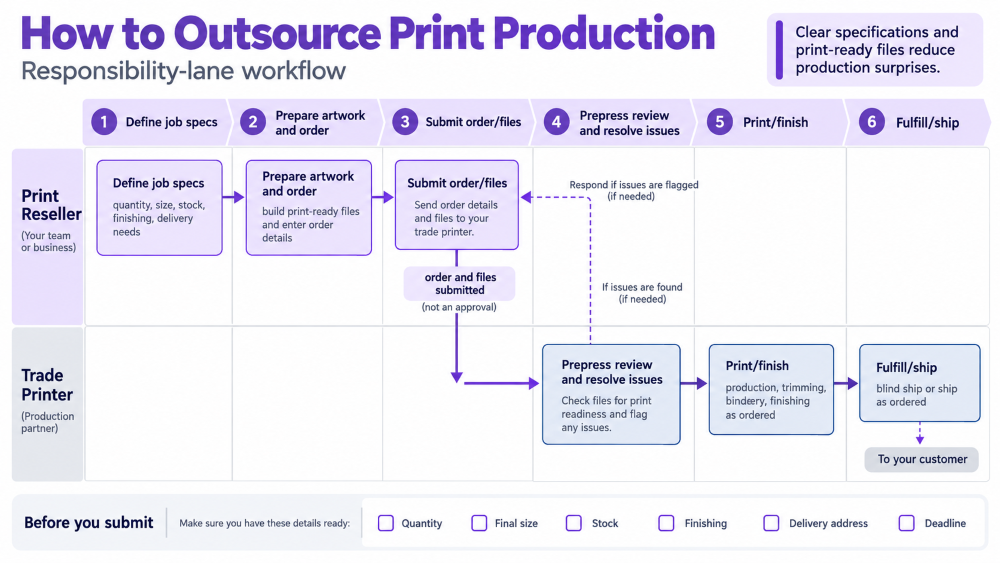
1. Collect Requirements
Capture:
- Quantity
- Size
- Stock
- Color requirements
- Finishing
- Delivery target
- Ship location
Example:
- 500 business cards
- 16pt stock
- Soft-touch coating
- Rounded corners
2. Route Production
Create rules.
Examples:
- Under 250 → digital
- Over 5,000 → wholesale offset
- Specialty finish → outsource
Standard rules improve quoting speed.
3. Prepare Files
Require:
- Bleeds
- Correct color mode
- Embedded fonts
- Linked assets
- Resolution verification
File issues create most avoidable delays.
4. Submit Production
Include:
- Artwork
- Specifications
- Packaging instructions
- Delivery instructions
Avoid vague production instructions
Bad: “Make this look right.”
Better: “100 lb gloss text, fold to finished size, carton pack.”
5. Produce and Finish
Typical wholesale workflow:
File review → Scheduling → Printing → Finishing → Packaging
6. Deliver
Options:
- Ship to reseller
- Blind ship
- Split shipment
- Pickup
Build freight into quoting.
Direct Answer #3
Profitable outsourcing relies on documented workflows, not manual exceptions.
In-House vs. Outsourced Print Production
| Factor | In-House | Outsourced |
|---|---|---|
| Equipment Cost | High | Low |
| Product Range | Limited | Broad |
| Capacity | Fixed | Flexible |
| Labor | Higher | Lower |
| Maintenance | Internal | External |
| Specialty Capability | Limited | Strong |
| Scalability | Slower | Faster |
| Cash Requirement | Higher | Lower |
Rule of Thumb
Predictable, high-volume work may fit in-house.
Variable demand usually favors outsourcing.
Direct Answer #4
Do not outsource only to lower cost. Outsource to increase capability and capacity.
Common Mistakes
Choosing only on price
Evaluate:
- Consistency
- Communication
- Packaging
- Reprint rates
- Reliability
Sending unverified files
Preflight before submission.
Overpromising timelines
Sell production schedules, not hopes. When using ND4C, check the current turnaround information when planning delivery expectations.
Excess customization
Standardization improves margins.
Missing documentation
Maintain:
- Product specs
- File standards
- Naming conventions
- SKU logic
Single-source dependence
Maintain backup production.
Direct Answer #5
Most outsourcing failures begin with unclear specifications, not printing defects.
Best Practices
Build Standard Product Menus
Reduce unnecessary combinations. Use the ND4C product catalog to review available wholesale production categories when matching customer needs to an outsourced production option.
Establish Routing Rules
Define what stays internal versus wholesale.
Create File Standards
Document:
- Bleed
- Safe area
- Resolution
- Export settings
Track Supplier Performance
Measure:
- On-time delivery
- Reprints
- Margin
- Response speed
Protect Customer Experience
Customers remember results.
Not production methods.
Common Questions
Is outsourcing profitable?
Usually, when pricing includes freight, handling, and service margin.
Does outsourcing lower quality?
Not inherently. Specialized production often improves consistency.
Should customers know?
Not necessary. The reseller owns the relationship.
Can small shops outsource?
Yes. Many operate primarily through wholesale production.
Is blind shipping common?
Very.
Frequently Asked Questions
1. What products are most commonly outsourced?
Business cards, booklets, direct mail, specialty finishing, and overflow work.
2. Should I outsource everything?
No. Hybrid production models are common.
3. How many suppliers should I maintain?
At least one backup.
4. What causes delays?
File errors, missing approvals, shipping issues.
5. Who owns mistakes?
Define responsibility before production.
6. Can rush jobs be outsourced?
Often yes, depending on freight and scheduling.
7. Should every shipment be inspected?
Audit early and spot-check later.
8. How do I protect margins?
Standardize products and pricing.
9. What should stay in-house?
High-frequency, repeatable work.
10. How quickly can outsourcing launch?
Simple programs can launch within days.
Related Guides
- Blind Shipping Explained
- Digital vs Offset
- Spot Color vs CMYK
- Wholesale Business Cards Guide
- Short Run Printing Explained
- Synthetic Print Guide
- File Setup Guide
- Turnaround Times Explained
Final Next Step
Outsourcing performs best as a documented operating model, not a last-minute overflow solution.
Standardize products. Build production rules. Select partners carefully.
When the process becomes predictable, growth becomes easier to scale.
ND4C is a wholesale trade printer with more than two decades of industry experience. Our Print Playbook guides draw on firsthand expertise across prepress, production, customer support, design, and print technology to help retail printers and print resellers make better production decisions.