PRINT PLAYBOOK GUIDE - PRINT COMPARISONS
Part of Series: Print Comparisons
Spot Color vs CMYK Printing: Differences & Best Uses
 ND4C Print Experts
Spot Color vs CMYK: What's the Difference?
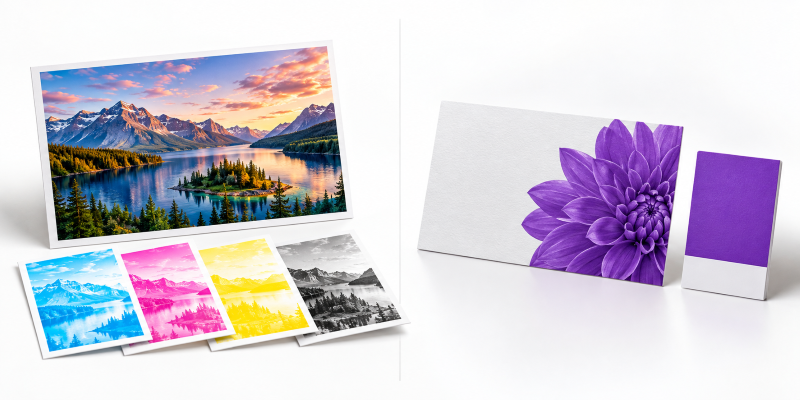
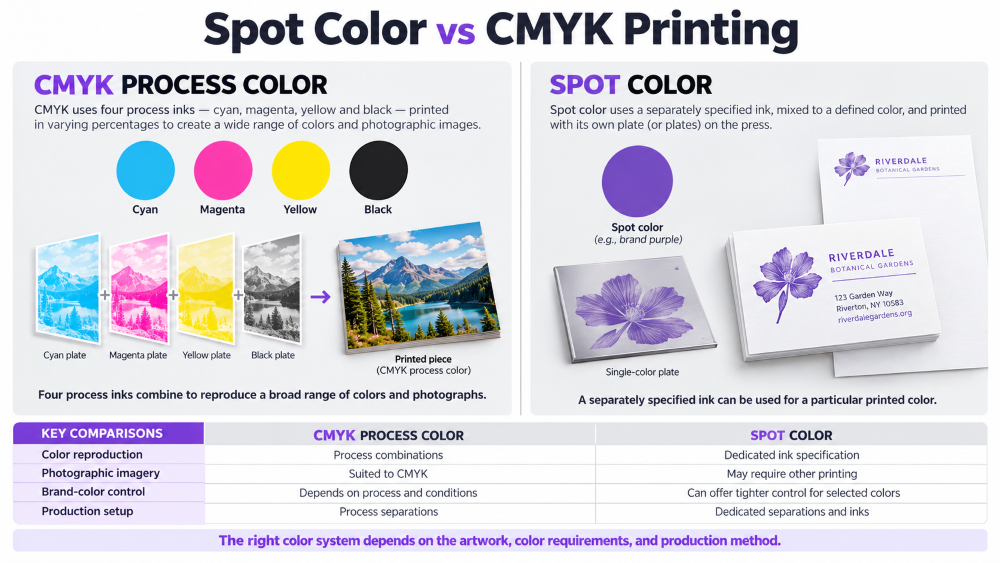
Spot color printing uses individually specified inks to reproduce particular colors, while CMYK printing combines cyan, magenta, yellow, and black inks to reproduce a broad range of colors. Spot color is generally preferable when a job requires a specific brand color or an ink that CMYK cannot reproduce accurately. CMYK is typically the better choice for photographs, gradients, and multicolor artwork.
Neither method is automatically more accurate or cost-effective for every job. The right choice depends on the artwork, color requirements, paper stock, quantity, and available production options.
For print resellers, the key question is whether the customer needs a specific ink color or an acceptable visual reproduction of that color.
Spot Color vs CMYK: Quick Comparison
| Factor | Spot Color | CMYK |
|---|---|---|
| Ink system | Individually specified inks | Cyan, magenta, yellow, and black |
| Color reproduction | Dedicated inks for selected colors | Process-ink combinations |
| Brand matching | Direct control over specified ink colors | Depends on the achievable process-color match |
| Photographs | Not practical for conventional full-color photography alone | Well suited |
| Color gamut | Certain inks exceed conventional CMYK capabilities | Broad range with defined gamut limitations |
| Color consistency | Defined ink reference supports repeatability | Depends on color management and production conditions |
| Typical applications | Corporate stationery, forms, brand-critical designs | Brochures, postcards, catalogs, photographic designs |
| Production setup | May require dedicated inks and additional setup | Uses standard process-color workflows |
| Cost | Depends on ink count, setup, stock, and quantity | Depends on production method, quantity, and efficiency |
What Is Spot Color Printing?
Spot color printing uses a separately specified ink rather than combining standard CMYK process inks to reproduce a particular color.
A common example is a company logo printed using a designated Pantone Matching System (PMS) color. The ink is selected or formulated to reproduce that specified color, subject to the printer's equipment, paper stock, and production conditions.
Spot color printing is commonly used for:
- Corporate letterhead and envelopes
- Business cards featuring one or two brand colors
- Branded forms and stationery
- Projects requiring specific Pantone colors
- Designs using metallic, fluorescent, or other specialty inks
Spot inks can also be screened to produce lighter tints, allowing a single ink to create multiple tonal values.
Pantone is a color specification system, not a printing method. A Pantone color reference identifies a target color, while spot-color printing describes how a dedicated ink is used to reproduce it.
What Is CMYK Printing?
CMYK printing reproduces colors using four process inks: cyan, magenta, yellow, and black.
These inks are printed in different combinations and screened percentages to create a wide range of colors and tonal variations.
CMYK is especially suitable for:
- Full-color brochures and flyers
- Postcards and marketing materials
- Catalogs and booklets
- Business cards with photographs or multicolor artwork
- Designs containing gradients, illustrations, or multiple logos
Many common brand colors reproduce successfully using CMYK. However, some highly saturated or specialized colors fall outside the range that a particular CMYK process can produce.
That achievable range is called the color gamut.
Key Differences Between Spot Color and CMYK
1. Brand Color Accuracy
Spot color printing offers more direct control over a designated brand color because the ink is specified independently of CMYK process combinations.
This can be particularly valuable for businesses with established brand standards or coordinated stationery programs.
For example, a company might use the same designated blue across its business cards, letterhead, and envelopes. Specifying a consistent spot ink provides a common color reference for those products.
However, the same spot ink does not guarantee an identical appearance on every paper.
Coated and uncoated stocks reflect light and absorb ink differently. Paper shade, ink coverage, and finishing can also affect the result.
CMYK can reproduce many brand colors acceptably, particularly when color management and production conditions are controlled.
Choose spot color when: A specific brand color is a critical production requirement and the selected printing workflow supports it.
Choose CMYK when: The process-color reproduction is acceptable and a dedicated ink is unnecessary.
2. Color Gamut and Specialty Colors
Certain spot inks can reproduce colors that conventional CMYK cannot accurately simulate.
Examples include some highly saturated colors, fluorescent inks, and metallic inks.
When a Pantone spot color is converted to CMYK, the resulting color may appear duller, less saturated, or noticeably different from the original.
However, not every spot color falls outside the CMYK gamut. Many can be reproduced reasonably well with process inks.
A Pantone Color Bridge guide provides side-by-side examples of spot colors and their CMYK simulations. It can help designers and resellers evaluate whether a process-color alternative is acceptable.
Actual results still depend on the printing conditions and substrate.
3. Photographs and Complex Artwork
CMYK is generally the practical choice for full-color photographs and designs containing numerous color variations.
Spot color printing is more appropriate when a job requires a limited number of individually specified colors.
Consider a promotional postcard containing a full-color photograph and a corporate logo.
CMYK can reproduce the photograph and logo together. If the logo requires a particularly strict color match, the job might benefit from an additional spot ink.
Some production workflows can combine CMYK and spot inks on the same job. Availability depends on the equipment and production arrangement.
4. Color Consistency and Repeat Orders
A specified spot ink provides a common reference for repeated production.
This can be helpful when a reseller supplies the same customer with multiple stationery products or reorders over time.
However, color consistency also depends on:
- Paper type and surface characteristics
- Press and ink conditions
- Printing method
- Color measurement and quality control
- Coatings and finishing
CMYK can also produce consistent results when color management and production conditions are properly controlled.
For customers with strict color expectations, resellers should establish the requirements before production and communicate any relevant approved samples or color references.
A Pantone number alone should not be treated as a guarantee of an exact visual match under all conditions.
5. Spot Color and CMYK Are Not Printing Methods Like Digital and Offset
Spot color and CMYK describe approaches to reproducing color. Digital and offset describe printing technologies.
These distinctions are related, but they are not interchangeable.
Conventional offset presses can print CMYK, spot inks, or combinations of both, depending on their configuration.
Digital presses commonly use process-color systems, although some support expanded color gamuts or specialty inks.
A job printed on an offset press is not automatically a spot-color job. Likewise, specifying a Pantone color in a digital file does not mean the job will use dedicated spot ink.
For a more detailed discussion of the production technologies, see Digital vs Offset Printing.
When Should You Choose Spot Color or CMYK?
| Printing Scenario | Recommended Approach | Primary Reason |
|---|---|---|
| Corporate letterhead with one designated brand color | Spot color | Supports a specific ink reference |
| Full-color marketing brochure | CMYK | Reproduces photographs and complex graphics |
| Business cards requiring a specific Pantone ink | Spot color | Provides dedicated ink reproduction |
| Promotional postcards with several photographs | CMYK | Supports varied colors and tonal detail |
| Two-color business forms | Spot color may be suitable | Works well with limited-color artwork |
| Full-color booklet containing a corporate logo | Usually CMYK | A separate spot ink may be unnecessary |
| Design requiring true metallic ink | Specialty spot ink | Conventional CMYK cannot reproduce the metallic ink effect |
These are general recommendations. Actual production suitability depends on available product specifications, inks, quantities, stocks, and finishing options.
Is Spot Color Printing Cheaper Than CMYK?
Neither approach is universally less expensive.
A one- or two-color spot job can be cost-effective when it fits an established production workflow. However, dedicated inks, separate setup, and additional production requirements may increase the cost of other spot-color jobs.
CMYK can be particularly cost-effective when the job fits an established full-color production workflow.
Several factors influence pricing.
Number of inks: A one-color spot job has different requirements from a job using several spot inks or combining spot colors with CMYK.
Quantity: Setup requirements and production volume influence the total cost and unit price.
Paper stock: Coated, uncoated, and specialty stocks can affect both printing costs and color appearance.
Standard versus custom specifications: Jobs that fit established product specifications often benefit from more efficient production arrangements.
Finishing and turnaround: Additional finishing, scheduling constraints, and delivery requirements can affect the overall cost.
A dedicated spot ink may be justified when precise brand-color reproduction is essential. When an acceptable CMYK alternative exists, the reseller should compare available production options before deciding.
How Does Gang-Run Printing Affect the Cost?
Gang-run printing combines compatible jobs on shared press sheets, spreading certain setup and production costs across multiple orders.
ND4C uses gang-run production to make many standard wholesale print products cost-effective.
Standard CMYK products can benefit from established gang-run workflows. Spot-color jobs require compatible inks and production arrangements, which may affect whether jobs can be grouped.
A request for a particular Pantone ink outside the standard product options may therefore require a custom estimate.
The important distinction is not that CMYK is always cheaper, but that standardized production often offers different cost advantages from customized production.
Does Print Quantity Change the Recommendation?
Quantity influences the production decision, but it should not override the artwork or color requirements.
A small order containing full-color photographs will generally favor an appropriate process-color workflow.
A larger stationery order with strict brand-color requirements may justify spot-color production.
Resellers should also consider inventory needs. If the printed information may become outdated, ordering fewer pieces can reduce waste even when the unit price is higher.
The best value depends on the customer's complete production requirements, not unit cost alone.
How to Prepare Artwork for Spot Color and CMYK
A common mistake is assuming that specifying a Pantone swatch in design software automatically causes a job to be printed with dedicated spot ink.
A Pantone designation in the file does not guarantee spot-color production.
The actual ink system depends on the product ordered, the printer's production capabilities, and the file preparation requirements.
Preparing Spot-Color Artwork
When ordering a dedicated spot-color product:
- Use the printer's artwork template and product specifications.
- Define the required spot inks using the supported color references.
- Preserve spot-color definitions rather than unintentionally converting them to CMYK.
- Check that artwork elements are assigned to the correct inks.
- Follow any required separation or file-submission instructions.
Spot-color file requirements can vary by product and production workflow.
Preparing CMYK Artwork
For standard process-color printing:
- Use the correct template, trim size, and bleed.
- Follow the printer's supported color workflow.
- Evaluate critical brand colors when converting to CMYK.
- Use suitable image resolution at final reproduction size.
- Check for unintended spot colors or other file setup issues.
ND4C generally works with artwork at 300 dpi at final reproduction size for routine commercial printing. Higher image resolution does not automatically improve printed color accuracy.
For complete preparation requirements, consult the File Setup Guide.
Spot Color Printing at ND4C
ND4C offers standard spot-color printing options for several products, including business cards, letterhead, envelopes, flyers, notepads, and NCR forms.
Available stock, ink, quantity, and finishing selections depend on the product.
What If Your Customer Needs a Specific Pantone Ink?
ND4C can accommodate requests for specific Pantone inks beyond the standard selectable spot-color options through a custom estimate.
Resellers should identify the required Pantone color when requesting an estimate so the appropriate production requirements can be evaluated.
This is especially relevant for customers with formal brand-color specifications or unusual ink requirements.
A reseller does not need to assume that an unlisted Pantone color is unavailable. However, the requested ink should be confirmed through the custom-estimate process before making production commitments.
Standard Full-Color Orders vs Dedicated Spot-Color Orders
A customer may supply a business card design containing a Pantone-defined logo while ordering a standard full-color product.
That does not mean the logo will be printed using its dedicated Pantone ink. The color may be reproduced through the selected CMYK production workflow.
When a specific spot ink is required, the reseller should select an appropriate spot-color product or request a custom estimate.
This distinction helps prevent misunderstandings about color accuracy and expected production results.
Practical Wholesale Printing Examples
Example 1: Coordinated Corporate Stationery
A company needs business cards, letterhead, and envelopes featuring the same designated corporate blue.
Spot color may be appropriate because the customer values a consistent ink reference across multiple products.
The reseller should confirm the available ink and stock options for each item and explain that the final appearance may vary between coated and uncoated papers.
If the required Pantone ink is not available through standard ordering, ND4C can evaluate the request through a custom estimate.
Example 2: Full-Color Marketing Campaign
A marketing agency needs postcards, brochures, and promotional inserts containing photographs, gradients, and multiple brand colors.
CMYK is generally the practical choice.
The reseller should verify whether any critical brand colors have acceptable process-color equivalents before production.
Example 3: Two-Color NCR Forms
A business needs NCR forms containing its logo, contact details, and a secondary accent color.
Spot-color printing may be suitable because the design uses a limited number of designated colors.
The reseller should verify the available ink selections, NCR configuration, and finishing requirements before ordering.
Key Takeaways
- Choose spot color when a dedicated ink reference, strict brand-color requirements, or a specialty color makes it appropriate.
- Choose CMYK for photographs, gradients, and complex multicolor artwork.
- Evaluate color expectations carefully. Neither system guarantees identical results across different papers and production conditions.
- Compare production costs by job. Ink count, quantity, stock, setup, and finishing all matter.
- Confirm how the job will be printed. A Pantone reference in the artwork does not automatically mean dedicated spot-ink production.
- Use a custom estimate when needed. ND4C can accommodate specific Pantone ink requests beyond standard ordering options.
The right choice is the printing approach that meets the customer's color expectations while fitting the available production requirements and overall budget.
Frequently Asked Questions
Is spot color printing more accurate than CMYK?
Spot color provides greater control over a specified ink color and can reproduce some colors more closely than conventional CMYK. However, both systems are affected by stock, equipment, and production conditions.
Is Pantone the same as spot color?
No. Pantone is a color specification system, while spot color is a method of printing with individually specified inks. Pantone references are commonly used to identify spot inks.
Can CMYK match a Pantone color?
Many Pantone colors have acceptable CMYK approximations, but others fall outside conventional CMYK's color gamut. A Pantone Color Bridge guide can help evaluate potential differences.
Does specifying a Pantone color guarantee spot-ink printing?
No. A Pantone color may be converted to CMYK when a job is produced through a standard process-color workflow. Dedicated spot-ink production must be supported and specified for the order.
Can you print CMYK and spot colors on the same job?
Yes. Suitable equipment can print CMYK alongside additional spot inks. The availability and cost depend on the printer's production capabilities and the specific job.
Is one-color spot printing cheaper than full-color printing?
It can be, but not always. Dedicated setup, quantity, paper stock, and the production workflow determine whether a one-color spot job is more economical than a standard CMYK option.
Why does the same Pantone color look different on coated and uncoated paper?
Coated and uncoated papers absorb and reflect ink differently. Paper shade and surface characteristics affect how a printed color appears, even when the same ink specification is used.
Is CMYK better for photographs?
Generally, yes. CMYK is designed to reproduce complex full-color images, while conventional spot-color printing is best suited to designs using a limited number of specified inks.
Can digital printing reproduce spot colors?
Many digital systems can simulate specified spot colors using process inks. Some also support additional specialty inks. The available capability depends on the equipment and does not necessarily involve using the original dedicated spot ink.
Can ND4C print a specific Pantone color that isn't listed online?
Yes. ND4C can accommodate specific Pantone ink requests beyond the standard selectable options through a custom estimate. Provide the Pantone reference when requesting the estimate.
Related Print Playbook Guides
- Digital vs Offset Printing: Compare printing technologies and their production advantages.
- Digital Printing Explained: Understand digital print production and common applications.
- Offset Printing Explained: Learn how conventional offset printing works.
- File Setup Guide: Review bleed, resolution, color, and artwork preparation.
- Gang Run Printing Explained: Understand shared-sheet production and efficiency.
- What Determines Wholesale Print Pricing?: Explore the factors that affect production cost.
- Wholesale Business Card Guide: Learn how to select business card specifications and production options.
ND4C is a wholesale trade printer with more than two decades of industry experience. Our Print Playbook guides draw on firsthand expertise across prepress, production, customer support, design, and print technology to help retail printers and print resellers make better production decisions.