PRINT PLAYBOOK GUIDE - PRINT COMPARISONS
Part of Series: Print Comparisons
How to Choose a Printing Method
 ND4C Print Experts
Quick Answer: How Do You Choose the Right Printing Method?
The right printing method depends on the complete job specification, including quantity, finished size, substrate, color requirements, finishing, turnaround, and total production cost. Digital printing is often practical for shorter runs and variable-data jobs, offset printing can provide favorable economics for longer runs, and wide-format or specialty printing may be needed for oversized pieces or particular materials. No single factor reliably determines the best method.
For print resellers, the decision also includes whether standard product specifications meet the customer's requirements, how much printed inventory is likely to be used, and whether a custom production estimate is necessary.
The best approach is to identify technically compatible production options first, then compare their total cost, quality, turnaround, and suitability for the job.
What Is Printing Method Selection?
30-Word Definition
Printing method selection is the process of evaluating job specifications, production capabilities, cost, quality, and delivery requirements to determine which printing process is most suitable for a particular print project.
Why printing method selection matters
Many commercial print products can be manufactured using more than one method. However, those methods differ in setup requirements, material compatibility, unit economics, finishing options, and production schedules.
Choosing a method based only on quantity or price can overlook requirements that make the job more expensive, difficult, or unsuitable for that process.
For print resellers, the goal is not necessarily to specify the press. It is to understand the customer’s requirements well enough to select suitable product configurations, compare total costs, and communicate realistic expectations.
The best method satisfies the complete specification at an acceptable cost and within the required production schedule.
Key Takeaways
- Start with the complete specification. Quantity alone does not determine the right printing method.
- Identify compatible production options before comparing price. Size, substrate, color, and finishing may eliminate certain methods.
- Compare digital and offset when both are viable. Their relative economics depend on quantity, setup, materials, and other requirements.
- Consider the risk of obsolescence. A smaller print run may be more economical when materials will become outdated before a larger quantity is used.
- Use established product configurations when possible. Curated catalog options simplify production decisions; unusual requirements may need custom estimating.
- Confirm artwork readiness and turnaround requirements. File problems and missed cutoffs can delay production regardless of the printing method.
How Does Printing Method Selection Work?
Choosing a printing method is a process of eliminating incompatible options and comparing the remaining alternatives. It is not a fixed formula that assigns every job to one technology.
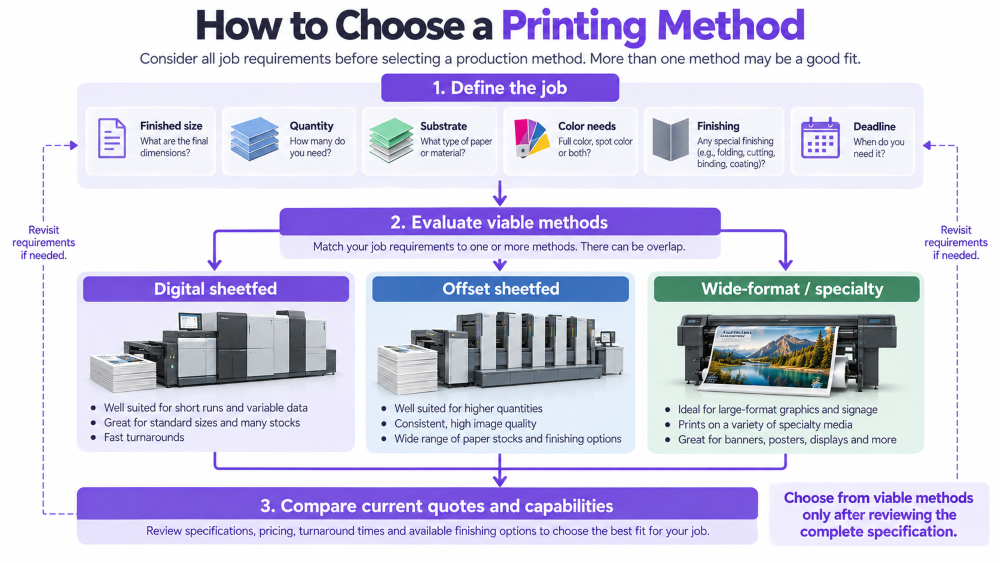
Printing Method Decision Path
Follow this sequence to narrow the production options before comparing quotes.
1. DEFINE THE COMPLETE JOB
Quantity • Finished size • Material • Color • Finishing • Deadline
2. IDENTIFY TECHNICALLY COMPATIBLE METHODS
Confirm size, substrate, ink, equipment, and finishing capabilities.
| Digital sheetfed | Offset sheetfed | Wide-format / specialty |
3. COMPARE CURRENT QUOTES AND CAPABILITIES
Total delivered cost • Quality • Turnaround • Inventory needs
Decision note: Multiple methods may be viable for the same job. If no standard catalog configuration meets the requirements, request production guidance or a custom estimate.
Step 1: Define the job before selecting equipment
Collect the information needed to determine how the finished product should be manufactured. At minimum, establish:
- Quantity: Required finished pieces, including separate designs, versions, or personalized pieces.
- Finished size: Dimensions after cutting, folding, or other finishing.
- Material: Paper weight, coating, synthetic substrate, rigid material, or specialty stock.
- Color requirements: Process color, spot inks, critical brand colors, or variable printing.
- Finishing: Cutting, folding, scoring, binding, coating, die cutting, or other operations.
- Turnaround: Required production and delivery schedule.
Also identify the product’s intended use, expected lifespan, and any special quality or tolerance requirements.
Step 2: Identify which methods can produce the job
The principal production families include:
Digital sheetfed printing uses digital imaging without conventional offset printing plates. Depending on the equipment, it can be suitable for short runs, multiple versions, and variable-data applications.
Offset sheetfed printing transfers ink using printing plates and an intermediate blanket. Conventional setup is an important part of production economics, while longer runs may benefit from efficient repeated impressions.
Wide-format printing generally serves applications involving larger printable dimensions, roll-fed materials, or supported rigid and specialty substrates. Many wide-format printing systems use digital technology.
Specialty printing processes including screen printing and flexography, serve particular applications, substrates, and production requirements.
These categories can overlap. Wide-format digital printing, for example, is both digital and wide-format.
For detailed explanations, see Digital Printing Explained, Offset Printing Explained, Poster Printing Explained.
How ND4C simplifies production choices
A reseller ordering a standard wholesale product does not necessarily need to choose the printing equipment or independently evaluate every technical compatibility issue.
ND4C’s ordering system presents carefully curated product configurations. Available sizes, stocks, coatings, and finishing options are selected to work together and support successful production.
Rather than allowing customers to select incompatible combinations, the catalog limits choices to established product specifications.
This allows resellers to focus on selecting a finished product that meets their customer’s needs without making every technical manufacturing decision themselves.
When a job requires features outside the available specifications, a custom estimate is required. ND4C’s print experts can then evaluate the requirements and help identify appropriate production options.
Practical takeaway
Start with the available product configurations. When they cannot accommodate the complete job, request a custom estimate rather than forcing the specifications into an unsuitable standard option.
Step 3: Eliminate incompatible methods
A production method should remain under consideration only if it can satisfy the essential job requirements. Common limitations include:
- Finished dimensions exceed available equipment capabilities.
- The required stock or substrate cannot run on the proposed equipment.
- Required inks or color tolerances cannot be achieved.
- Necessary finishing operations are unavailable or incompatible.
- The production and delivery schedule cannot meet the deadline.
- The method cannot accommodate required personalization or versioning.
Do not assume a process is suitable simply because it can print a similar product.
Step 4: Compare viable production options
Once compatibility is established, evaluate:
- Total production cost and cost per finished piece
- Setup requirements and material usage or waste
- Quality and color expectations
- Finishing availability and cost
- Production schedule
- Packaging and shipping
- Inventory requirements and possible obsolescence
A lower unit price is not necessarily the lowest overall expense.
Step 5: Confirm the production plan
Before accepting a quote or submitting the order, verify that the proposed product and production process meet the complete specification.
Unusual tolerances, materials, finishing, or color requirements should be reviewed with the printer before approval.
For standard products, confirm the selected options and artwork requirements. For specifications outside the established catalog, request a custom estimate.
What Factors Determine the Right Printing Method?
The following production variables should be evaluated together.
| Factor | Why it matters |
|---|---|
| Quantity | Changes setup efficiency, unit economics, and inventory requirements |
| Finished size | Determines equipment compatibility and sheet or material utilization |
| Stock or substrate | Limits available equipment, inks, and finishing processes |
| Color requirements | Affects process selection, ink options, and achievable reproduction |
| Finishing | May require specialized equipment, compatible materials, or additional stages |
| Turnaround | Depends on order cutoffs, artwork readiness, scheduling, finishing, and shipping |
| File requirements | Affect prepress readiness, output quality, and production timing |
| Quality expectations | May require specific processes, samples, tolerances, or additional verification |
Does quantity determine the printing method?
Quantity influences method selection, but it does not determine the method by itself.
A small order may favor digital production because conventional offset setup represents a significant portion of the total cost. As quantity increases, offset may become more economical.
However, size, stock, color, finishing, and equipment availability can change that relationship. There is no universal quantity at which every print job should switch from digital to offset.
Quantity also affects inventory. A larger order may provide a lower unit price while creating unnecessary expense if much of the inventory is never used.
See How Quantity and Print Run Length Affect Unit Cost for a deeper explanation.
How does finished size affect production?
Finished size determines whether the product fits the equipment’s printable area and how efficiently pieces can be arranged on a larger sheet.
Two jobs with identical quantities and stocks may have different costs because their dimensions require different sheet layouts or produce different amounts of waste. Finished size can affect:
- Parent-sheet selection
- Number of pieces produced per sheet
- Cutting and finishing requirements
- Equipment compatibility
- Material waste
- Packaging and shipping
An oversized piece may require wide-format production. However, the required method depends on the actual dimensions and equipment capabilities.
How do stock and substrate affect the choice?
The material must be compatible with both the printing process and the required finishing operations.
Paper weight, thickness, coating, texture, rigidity, and synthetic composition can influence suitability. For example, a textured stock may reproduce color differently from a smooth coated sheet. A synthetic material may require particular inks, imaging systems, handling procedures, or finishing processes.
A material available with one printing method may not be compatible with another.
Within ND4C’s standard catalog, customers select from product options curated for production compatibility. Unusual materials outside those established specifications require a custom estimate.
How do color requirements affect production?
Color requirements can influence production selection, particularly when a customer specifies actual spot inks, critical brand colors, or narrow color tolerances.
Four-color process printing uses cyan, magenta, yellow, and black to reproduce a broad range of colors. Both digital and offset systems can use process-color approaches, although results depend on equipment, inks, materials, and color management.
Offset equipment can use separately formulated spot inks. Some digital presses also support specialty colors, but capabilities differ by equipment.
A digitally simulated spot color should not automatically be treated as equivalent to printing with the specified spot ink.
For color-critical work, clarify whether the requirement is a visual target, an approved sample, or a defined tolerance.
Is offset printing always better quality than digital?
No. Modern professional digital printing can deliver print quality comparable to offset for many commercial applications.
ND4C uses HP Indigo digital printing technology to produce offset-quality work at digital run lengths.
For resellers, this means shorter quantities do not automatically require accepting a lower standard of commercial print quality.
The appropriate method still depends on the full specification, including material, color requirements, finishing, and quantity. Actual results should be evaluated against the job’s requirements rather than assuming that offset inherently produces better output.
How do finishing requirements affect method selection?
Finishing can influence production requirements before the first sheet is printed. Common operations include:
- Folding or scoring heavier stocks
- Binding multi-page booklets
- Die cutting unusual shapes
- Applying coatings or laminates
- Adding perforations
- Producing specialty finishes
A process may print the artwork successfully while the selected material or format remains incompatible with the required finishing.
For ND4C’s standard products, available finishing options are curated for compatibility with the associated configurations. Customers are not expected to independently determine which combinations will work.
When a job requires finishing outside the published product options, a custom estimate is needed so the requirements can be evaluated.
Practical takeaway
Define the finished product, not merely the printed sheet. If the required finishing is unavailable within the standard product configuration, request a custom estimate.
How does turnaround influence the decision?
Turnaround depends on the entire production workflow, including order submission, artwork readiness, scheduling, printing, finishing, and shipping.
Digital production may reduce conventional setup requirements, but that does not guarantee an earlier shipment.
For ND4C orders, two factors are especially important:
- Meet the published order cutoff. The order, including all required artwork, must be submitted before the applicable cutoff time to qualify for the corresponding production schedule.
- Submit completely print-ready files. Missing bleeds, incorrect finished sizes, and text placed too close to trim commonly delay production until corrected artwork is supplied.
Rush production reminder
Most ND4C jobs offer a Rush turnaround option. Selecting Rush does not eliminate the need to meet the applicable cutoff or supply acceptable files. An order placed before the cutoff can still be delayed if artwork requires correction.
Practical takeaway: Check the current product turnaround and cutoff, select Rush when appropriate, and verify the artwork before submitting the order.
For a deeper explanation, see Turnaround Times Explained.
How Does Printing Method Affect Cost?
Printing method affects the balance of setup expenses, material consumption, production efficiency, finishing costs, and unit economics.
Total delivered cost
Setup cost + production cost + finishing cost + packaging and shipping = total delivered cost
These expenses vary according to the process, equipment, and job specification.
Setup costs
Offset production generally requires printing plates and press make-ready. These costs can be spread across additional pieces as the quantity increases.
Digital production does not require conventional offset plates, although prepress, equipment setup, calibration, and other production expenses may still apply.
Production costs
Production costs can include labor, ink or imaging supplies, material consumption, equipment time, and waste.
Press speed alone does not determine cost. Sheet utilization, ink coverage, stock pricing, quantity, and operating efficiency also matter.
Finishing costs
Finishing may involve setup charges, per-piece costs, or both. Complex binding, scoring, folding, coating, and die cutting can materially change the total job cost.
A lower printing price does not necessarily produce a lower finished-product price.
Unit cost
Unit cost is the total applicable job cost divided by the number of acceptable finished pieces.
As quantity increases, fixed costs can be distributed across more units. However, unit costs do not necessarily decline at a constant rate, and different production methods can become competitive at different quantities.
Shipping costs
Finished dimensions, weight, quantity, packaging, and delivery requirements can affect shipping costs.
Compare delivered prices when production options result in different packaging requirements or shipment sizes.
Why the lowest unit cost is not always the best choice
A larger print run may reduce the price per piece, but purchasing more inventory than the customer can use creates its own cost.
Example: Lower unit cost vs. inventory obsolescence
A customer ordering promotional brochures may compare a shorter run of 500 brochures with a larger run of 5,000 brochures. The larger run may offer a lower unit price but greater exposure to obsolete inventory.
If the customer only distributes 500 brochures before the campaign changes, the remaining 4,500 pieces from the larger run become obsolete.
The better purchasing decision depends on expected usage, not unit price alone.
ND4C production insight: Short Run vs. Regular
ND4C customers can compare Short Run and Regular pricing, including available quantity options and quantity breaks.
Short Run may be more sensible for frequently updated materials, temporary promotions, or projects with uncertain demand, even when a larger Regular order offers a lower unit price.
Regular production may be more economical when the customer expects to use the entire quantity and the larger purchase is justified.
For resellers, the relevant comparison includes:
- Total order cost
- Cost per piece
- Expected usage
- Storage requirements
- Risk of outdated content
- Potential waste
- Future reordering needs
Decision rule
Order the quantity the customer can reasonably use rather than automatically choosing the lowest available unit price.
What specification changes can reduce printing costs?
Several variables may provide opportunities to reduce cost:
- Quantity: Compare available quantity breaks and appropriate Short Run or Regular options.
- Finished size: A standard dimension or more efficient layout may reduce material usage or finishing complexity.
- Stock: A different compatible paper or substrate may provide a better balance of cost and performance.
- Finishing: Removing or simplifying unnecessary finishing operations may reduce production expenses.
- Turnaround: Choosing a standard schedule instead of Rush may avoid additional expedited charges where applicable.
- Shipping: Adjusting shipment requirements may affect delivery expenses.
There is no single adjustment that always produces the greatest savings. The reseller should identify which specifications are essential and which can change without compromising the customer’s intended result.
For more detail, see How Quantity and Print Run Length Affect Unit Cost.
Digital vs. Offset vs. Wide-Format Printing: How Do They Compare?
The following table summarizes common characteristics. Actual capabilities depend on the equipment and production provider.
| Factor | Digital sheetfed | Offset sheetfed | Wide-format / specialty |
|---|---|---|---|
| Typical applications | Business cards, short-run brochures, postcards | Brochures, stationery, higher-volume commercial products | Posters, signs, banners, specialty products |
| Quantity economics | Often competitive at smaller quantities | Can become favorable at longer run lengths | Depends on process, dimensions, and material |
| Setup | No conventional offset plates; other setup may apply | Printing plates and press make-ready | Varies by technology |
| Color | Process color and supported specialty configurations | Process color and conventional spot-ink options | Equipment-specific capabilities |
| Substrates | Equipment-approved paper and specialty stocks | Compatible press-approved stocks | Roll materials, specialty sheets, supported rigid substrates |
| Size | Limited by equipment and sheet handling | Limited by press and sheet dimensions | Often supports larger dimensions |
| Variable data | Common capability | Generally requires an additional digital process | Available on compatible digital systems |
| Finishing | Depends on workflow | Depends on workflow | Application-specific |
| Turnaround | May benefit from reduced conventional setup | Requires make-ready and scheduling | Depends heavily on material and finishing |
Important distinction
Wide-format is not a printing technology separate from digital. Many wide-format systems use digital printing, and some applications overlap with sheetfed production.
For a detailed comparison of the two conventional commercial methods, see Digital vs Offset Printing.
Advantages and Limitations of Common Printing Methods
Digital printing
Advantages: Digital printing can provide professional commercial output without conventional offset plate-making. It is often efficient for shorter runs, multiple versions, variable-data applications, and production requiring flexibility.
ND4C uses HP Indigo technology to produce offset-quality output at digital run lengths, allowing customers to order smaller quantities without automatically sacrificing commercial print quality.
Limitations: Unit economics may become less favorable for longer runs. Available dimensions, substrates, inks, and finishing depend on the specific equipment.
Consider digital when: The job involves a shorter run, personalization, multiple versions, or production conditions that benefit from reduced conventional setup.
Offset printing
Advantages: Offset can provide favorable economics for longer runs, controlled repeated production, and conventional spot-ink capabilities.
Limitations: Plate-making and press make-ready add setup requirements that may be inefficient for smaller quantities.
Consider offset when: A standardized design is being produced in substantial quantity, actual spot inks are required, or the available equipment and material combination make offset competitive.
Offset should not be selected simply because it is assumed to provide better quality than digital.
Wide-format and specialty printing
Advantages: These production approaches can accommodate larger dimensions, supported specialty substrates, and applications outside the capabilities of standard commercial sheetfed equipment.
Limitations: Material compatibility, finishing, equipment availability, handling, and costs vary significantly.
Consider wide-format or specialty production when: Dimensions, substrate, display requirements, or specialized product features make the equipment appropriate.
How to Decide Which Printing Method to Use
The most practical approach is to identify mandatory requirements first, compare compatible product configurations, and evaluate total costs and production expectations.
Practical decision rules
| If the job... | Investigate... |
|---|---|
| Has a small quantity | Compatible digital or Short Run options; also consider expected usage and possible obsolescence. |
| Has a large quantity | Digital and offset economics where both are viable; verify that the full quantity is needed. |
| Is oversized | Available sheetfed dimensions and wide-format capabilities. |
| Requires a specific spot ink | A process that can use the required ink or an explicitly acceptable alternative. |
| Requires variable data | Compatible digital or hybrid production plus data and verification requirements. |
| Has unusual material or finishing | Standard catalog options first; a custom estimate if the requirement falls outside them. |
| Has urgent turnaround | Published cutoffs, complete artwork readiness, Rush availability, and shipping schedule. |
Example 1: A short run of standard business cards
A customer needs a relatively small quantity of full-color business cards on an approved stock. Digital sheetfed production is a logical method to investigate because conventional offset setup may not be justified at that quantity.
However, a reseller ordering from ND4C may not need to choose the press at all. The available product configurations already account for compatible production options.
Decision: Compare standard product and Short Run prices, confirm the required specifications, and select the quantity that matches the customer’s needs.
Example 2: A large brochure order with multiple folds
A reseller is quoting a substantial quantity of full-color brochures with a specified finished size and folding pattern. Digital and offset may both be technically viable, depending on equipment and stock.
Important considerations include:
- Total quantity
- Sheet utilization
- Material and setup costs
- Folding or scoring requirements
- Production schedule
- Expected inventory usage
If the customer’s information changes frequently, a smaller order may be more sensible even when a larger print run offers better unit pricing.
Decision: Compare matching product specifications and quantities, including the risk of inventory becoming obsolete.
Example 3: An oversized promotional poster
A customer requests a poster larger than the printable area of available conventional sheetfed equipment. Wide-format production becomes an important option because it may support the dimensions.
The choice still depends on material, display conditions, image quality, quantity, and finishing requirements.
Decision: Confirm the required size and intended application, then select an appropriate available product or request a custom estimate when standard options do not fit.
Example 4: A custom product with unusual finishing
A customer requests a printed product with a finishing feature not available in the standard catalog configuration.
Rather than allowing the reseller to select an untested combination, ND4C’s ordering system restricts the available options to established specifications.
Decision: Request a custom estimate. Print specialists can review the material, dimensions, finishing requirements, and other specifications to identify an appropriate production approach.
When Should You Ask a Printer for Guidance?
Ask for production guidance when the job falls outside standard product specifications or when important requirements cannot be confirmed through the available ordering options.
Print resellers do not need to determine every technical detail of the manufacturing process. They do need to describe the customer’s requirements accurately.
Situations that commonly warrant additional evaluation include:
- Nonstandard finished sizes
- Materials outside available catalog options
- Specialized coatings or finishing
- Critical color requirements
- Tight registration or dimensional tolerances
- Unusual quantities
- Complex personalization
- Custom packaging
- Special production or delivery requirements
When does ND4C require a custom estimate?
ND4C offers an extensive range of standard configurations, with options curated for production compatibility. When a customer needs a feature outside those established specifications, a custom estimate is required.
The custom estimating process allows ND4C’s print experts to evaluate the complete job and help identify appropriate production options.
Where specific tolerances or expectations are important, these can be discussed during estimating and approval.
Practical takeaway
Standard catalog configurations simplify routine production. Custom estimates provide a path for jobs requiring features or production considerations outside the established options.
Common Printing Method Selection Mistakes
1. Choosing a method based only on quantity
Why it matters: Quantity affects economics, but the lowest unit price does not guarantee the best purchasing decision.
Better approach: Confirm technical compatibility, compare current pricing, and consider actual usage and the possibility of obsolete inventory.
2. Assuming digital printing is lower quality than offset
Why it matters: Modern professional digital equipment can produce output comparable to offset for many commercial applications. ND4C’s HP Indigo press provides offset-quality printing at digital run lengths.
Better approach: Evaluate the actual equipment, materials, color requirements, and finished result instead of assuming offset is inherently superior.
3. Comparing printing prices without finishing and shipping
Why it matters: A lower printing charge may be offset by finishing, packaging, or shipping expenses.
Better approach: Compare total delivered prices for matching specifications.
4. Assuming every printer supports the same materials
Why it matters: Equipment varies in stock thickness, surface compatibility, handling, and finishing capabilities.
Better approach: Use approved product configurations or confirm unusual materials through custom estimating.
5. Ignoring critical color requirements
Why it matters: Process-color reproduction, actual spot inks, and digital color simulations are not interchangeable for every application.
Better approach: Identify required color standards and acceptable tolerances before approving the production approach.
6. Choosing the printing method before planning finishing
Why it matters: Binding, scoring, folding, die cutting, and coatings can change equipment and material requirements.
Better approach: Define the finished product completely. Use compatible catalog options or request a custom estimate.
7. Assuming standard specifications cover unusual requirements
Why it matters: A standard product has an established range of available sizes, materials, and finishing options.
Better approach: When the customer needs something outside that range, obtain a custom estimate and confirm critical expectations.
8. Assuming order submission guarantees the turnaround
Why it matters: Missing bleeds, incorrect finished sizes, and text too close to trim delay production until corrected files are provided. Missing a published cutoff can also affect scheduling.
Better approach: Confirm the applicable cutoff and check that all artwork is completely print-ready before submitting the order, particularly when using Rush turnaround.
Printing Method Selection Checklist
Use this checklist before quoting or submitting a print job.
- ☐ Confirm finished dimensions and orientation
- ☐ Identify the required quantity and any separate versions
- ☐ Determine expected usage and risk of inventory obsolescence
- ☐ Select the appropriate stock or substrate
- ☐ Document color requirements and any critical matches
- ☐ Include all finishing requirements
- ☐ Review available standard product configurations
- ☐ Compare compatible production options and total costs
- ☐ Check current turnaround, order cutoffs, and Rush availability
- ☐ Verify bleeds, finished size, and safe text placement
- ☐ Confirm shipping and delivery requirements
- ☐ Request a custom estimate if the job falls outside standard specifications
Common Questions About Choosing a Printing Method
What is the best printing method for a print job?
The best method satisfies the complete job specification at an acceptable total cost and within the required schedule. Quantity, size, material, color, finishing, quality, and delivery requirements must be evaluated together.
Does quantity determine whether to use digital or offset printing?
No. Quantity affects production economics, but the digital-to-offset cost relationship varies with equipment, stock, finished size, finishing, and setup. Compare actual quotes when both processes are suitable.
When should digital printing be considered?
Digital printing should be considered for shorter runs, multiple versions, personalized printing, and applications where its capabilities and reduced conventional setup provide an advantage.
When should offset printing be considered?
Offset may be appropriate for longer runs, jobs requiring conventional spot inks, or applications where available offset equipment provides favorable production economics.
When is large-format or wide-format printing needed?
Wide-format printing becomes an important option when dimensions or material requirements exceed the capabilities of available conventional sheetfed equipment. Some applications may be produced using either method.
Can the same product be printed using different methods?
Yes. Products such as business cards, brochures, flyers, postcards, and posters may be compatible with different printing methods depending on their specifications and the equipment available.
How does paper stock affect the printing method?
Paper weight, thickness, coating, texture, and material composition affect equipment compatibility, ink behavior, handling, and finishing. A stock suitable for one process may not be compatible with another.
Is offset printing always better quality than digital printing?
No. Professional digital printing can produce output comparable to offset for many commercial applications. ND4C uses HP Indigo technology to provide offset-quality printing at digital run lengths. The appropriate method depends on the complete specification.
Does digital printing always have a faster turnaround?
No. Digital printing can reduce conventional setup requirements, but total turnaround depends on scheduling, file readiness, finishing, material availability, and shipping.
Can finishing requirements change the printing method?
Yes. Folding, binding, scoring, die cutting, coatings, and other finishing operations can affect which equipment, materials, and production methods are suitable.
How should variable-data printing affect the decision?
Jobs containing unique names, addresses, codes, or other personalized information generally warrant evaluation of compatible digital production or suitable hybrid workflows. Data preparation and verification are also important.
Can wide-format printing be digital printing?
Yes. Many wide-format systems use digital printing technology. Digital describes the imaging approach, while wide-format generally describes equipment and applications supporting larger printing dimensions.
Should a reseller choose the printing method or let the trade printer decide?
The reseller should define the customer’s requirements and understand the tradeoffs. The trade printer can confirm compatible production options. ND4C simplifies this process through curated catalog configurations and custom estimating for requirements outside standard specifications.
When should a reseller choose Short Run instead of Regular printing?
Short Run may be preferable when demand is limited or printed information could become outdated before a larger quantity is used. Compare pricing, expected usage, total expenditure, storage, and obsolescence rather than relying only on unit price.
When does a job require a custom estimate?
At ND4C, a custom estimate is required when the job needs features outside established product specifications. The estimating process allows print specialists to evaluate unusual requirements and advise on suitable production options.
Related Production Guides
These guides provide deeper explanations of the processes and considerations used in printing method selection.
Digital Printing Explained — Understand digital production, equipment characteristics, applications, and limitations.
Offset Printing Explained — Explore offset production, printing plates, make-ready, run efficiency, and common applications.
Digital vs Offset Printing — Compare the two methods directly, including economics, quality, materials, and turnaround.
Poster Printing Explained — Understand equipment and material considerations for oversized and specialty printed products.
How Quantity and Print Run Length Affect Unit Cost — Learn how fixed costs, run length, sheet utilization, and production efficiency affect unit economics.
File Setup Guide — Review artwork requirements that help prevent prepress delays and production problems.
Additional related resources include Short Run Printing Explained, Turnaround Times Explained, How to Outsource Print Production.
Related Products and Applications
Printing method selection applies across many ND4C product categories.
| Product / application | Important production considerations |
|---|---|
| Business Cards | Quantity, stock, coating, color, finishing |
| Postcards | Quantity, dimensions, paper weight, mailing requirements |
| Brochures & Flyers | Run length, sheet utilization, folding, scoring |
| Catalogs & Booklets | Page count, stock, binding, schedule |
| Posters | Dimensions, material, quantity, display application |
| Synthetic Menus & Brochures | Substrate compatibility, durability, finishing |
| Short Run Products | Quantity flexibility, content changes, obsolescence |
Review available configurations through the ND4C wholesale printing catalog. Wholesale pricing is available to registered customers.
Final Next Step: Compare the Job, Not Just the Press
Start with the finished product’s requirements. Review compatible product configurations, compare quantities and total costs, and confirm that the artwork and schedule are appropriate.
For standard jobs, use available catalog options. For unusual specifications, request a custom estimate before finalizing the order.
ND4C is a wholesale trade printer with more than two decades of industry experience. Our Print Playbook guides draw on firsthand expertise across prepress, production, customer support, design, and print technology to help retail printers and print resellers make better production decisions.