PRINT PLAYBOOK GUIDE - PRODUCTS & APPLICATIONS
Part of Series: Products & Materials
Wholesale Business Card Guide
 ND4C Print Experts
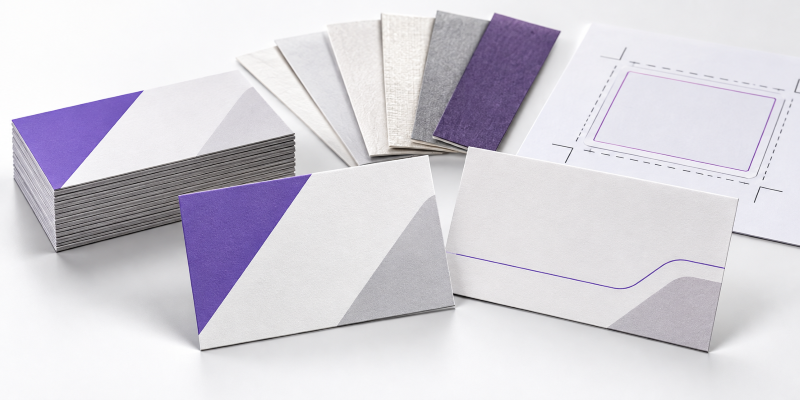
Compare wholesale business card sizes, paper stocks, coatings, specialty finishes, quantities, and artwork requirements to make better production decisions.
Quick Answer: What Should You Consider When Ordering Wholesale Business Cards?
When ordering wholesale business cards, consider the finished size, stock type, thickness, printing sides, coatings or specialty finishes, quantity, and artwork requirements. These specifications determine how the cards look and feel, how they function, and what they cost.
For print resellers, the best business card is not necessarily the thickest or most elaborately finished option. It is the combination of specifications that meets the customer's needs while keeping production practical and cost-effective.
Key Takeaways
- Standard business card sizes and catalog specifications generally offer the most economical production options.
- Stock thickness affects the feel of a card, but thickness alone does not determine quality, stiffness, or price.
- Coatings, lamination, and decorative finishes should support a specific design or functional purpose.
- Single-sided and double-sided printing serve different needs. Both are available across ND4C's standard business card categories.
- Short-run and regular production have different cost structures, making quantity an important ordering decision.
- Print-ready artwork and accurate specifications prevent avoidable delays, corrections, and reprints.
What Are Wholesale Business Cards?
Wholesale business cards are professionally printed cards produced by a trade printer for resale through retail print shops, graphic designers, brokers, marketing agencies, and other print professionals.
The reseller manages the customer relationship, design, product selection, and selling price while the wholesale printer handles manufacturing and, when arranged, fulfillment.
Business cards are particularly suitable for wholesale production because many orders share common sizes, stocks, and finishes. Compatible jobs can often be combined through gang-run printing, helping keep standard products economical.
The reseller's primary responsibility is matching the customer's needs to the appropriate production specifications.
How Are Wholesale Business Cards Produced?
Business card production begins with selecting the finished size, stock, printing sides, color requirements, finish, quantity, and turnaround.
Artwork is then prepared using the selected product's specifications and submitted for review. Depending on the product and order quantity, cards may be produced digitally or through offset printing, including gang-run production when appropriate.
After printing, applicable coatings or specialty finishes are completed, and the cards are trimmed, packaged, and shipped.
At ND4C, blind shipping is available for resellers who want orders delivered directly to their customers without identifying the wholesale printer.
Production consideration: Business card specifications are interconnected. Changing a stock, finish, or quantity can affect production compatibility, pricing, and available options.
What Business Card Size Should You Choose?
The standard U.S. business card measures 3.5 × 2 inches. This format fits common wallets and card holders and is widely supported by commercial printers.
Alternative sizes and shapes can create a distinctive presentation, but should be selected for a practical or design-related reason.
| Size or Format | Main Advantage | Main Consideration |
|---|---|---|
| Standard 3.5 × 2 inches | Familiar, versatile format | Conventional dimensions |
| Square or alternate catalog size | Distinctive presentation | Check availability and storage compatibility |
| Shaped business card | Distinctive silhouette | Follow the exact product template |
| Foldover business card | Additional information space | Plan fold orientation and layout |
| Custom dimensions | Greater design flexibility | May require a custom estimate |
ND4C offers shaped and foldover business cards as standard catalog products. Selecting one of these formats does not automatically require a custom estimate.
When Should You Choose a Custom Size?
Choose a custom size when the dimensions genuinely improve the card's intended purpose.
If an existing catalog format meets the customer's requirements, it will generally offer a more efficient production path. Unusual dimensions outside the catalog may require separate production arrangements and a custom estimate.
Which Wholesale Business Card Format Is Best?
Different business card categories serve different customer needs. Start with the intended use rather than automatically recommending a premium finish.
| Business Card Format | Best Starting Application |
|---|---|
| Standard | Everyday networking, sales teams, general business use |
| Premium | Brands seeking a more substantial or distinctive presentation |
| Short-run digital | Small quantities, changing information, testing designs |
| Foil | Metallic accents, logos, decorative details |
| Foldover | Appointment information, extra messaging, service details |
| Shaped | Distinctive branding and specialty applications |
| Spot-color | Designs requiring supported spot-ink production |
These categories describe common applications, not interchangeable production specifications.
ND4C product note: Available sizes, cardstock weights, and finishing options vary by product. Always review the specifications for the exact business card category being ordered.
How Do You Choose the Right Business Card Stock?
Paper stock influences a business card's thickness, stiffness, texture, surface appearance, and compatibility with coatings and specialty finishes.
Two stocks with similar thickness can feel and perform differently because of their composition and surface treatment.
Coated vs. Uncoated Business Card Stock
| Factor | Coated Stock | Uncoated Stock |
|---|---|---|
| Surface | Smoother, often more polished | More natural paper texture |
| Appearance | Often supports vibrant graphics | Typically softer, understated appearance |
| Ink behavior | Coating limits absorption | Ink generally absorbs more into paper |
| Writing | Depends on coating and pen | Often better suited to handwriting |
| Typical use | Photography, colorful graphics | Minimalist designs, notes, natural aesthetics |
Neither option is universally better. A coated stock may be appropriate for a colorful business card with photographic elements. Uncoated stock may be more useful for a card that needs to accommodate handwritten notes.
For a detailed comparison, see Coated vs. Uncoated Paper: Differences & Best Uses.
How Does Business Card Thickness Matter?
Cardstock thickness is commonly measured in points (pt), with one point representing approximately 0.001 inch of caliper. A nominal 14pt stock is approximately 0.014 inch thick.
ND4C's primary cardstock thicknesses include 14pt, 16pt, and 18pt, but these weights are restricted to particular products and are not universally available across every business card category.
Thicker cardstock can create a more substantial feel, but thickness alone does not establish quality, durability, or value.
Consider the intended presentation, handling requirements, available finishes, and cost before choosing a heavier stock.
For deeper guidance, see the Print Playbook's Cardstock Guide and 14pt vs. 16pt Business Cards comparison.
Does Stock Type Affect Wholesale Business Card Pricing?
Yes. Stock composition, thickness, surface treatment, availability, and manufacturing requirements can all influence pricing.
Two stocks with the same nominal caliper may have different costs. Compare the actual product specifications and available options rather than assuming one cardstock weight or stock family is always the better value.
ND4C also offers physical sample packs, which can help resellers evaluate stock appearance and feel before recommending a particular option.
Which Business Card Coatings and Finishes Should You Choose?
Finishes influence the surface appearance, texture, handling characteristics, and presentation of a business card. Choose a finish based on its contribution to the design and how the card will be used.
| Finish | Typical Effect | When to Consider It |
|---|---|---|
| Gloss coating | Reflective, shiny surface | Colorful or photographic designs |
| Matte finish | Lower-glare appearance | Understated branding |
| UV gloss coating | High-gloss cured surface | Designs emphasizing gloss |
| Silk lamination | Smooth laminated surface | Premium tactile presentation |
| Spot UV | Selective glossy accents | Logos, patterns, design details |
| Foil | Metallic decorative accents | Reflective embellishment |
| Uncoated surface | Natural paper feel | Writable cards and paper-focused designs |
ND4C finishing note: ND4C offers silk lamination, Spot UV, and foil on supported business card products. Availability depends on the product and its approved stock/finish combination. Not every finish is available with every stock or card format.
When Does Spot UV Make Sense?
Spot UV adds a glossy coating to selected areas of a design rather than the entire surface.
It can emphasize a logo, pattern, or other detail through contrast with the surrounding finish.
Spot UV works best when applied intentionally. Excessive small details or overly complicated coating patterns may reduce the effectiveness of the design.
Specialty finishing may require separate artwork elements or production files, so the finish should be selected before the design is finalized.
For detailed preparation guidance, see Spot UV Printing: How It Works and How to Prepare Your Files.
When Should You Consider Foil or Silk Lamination?
Foil is useful when a customer wants metallic decorative elements that stand out from conventional process printing. It is often chosen for logos, names, or selected design accents.
Silk lamination provides a distinct surface feel and can support a more polished presentation.
These options should be selected for their visual or tactile value, not simply because they are considered premium.
ND4C restricts specialty finishes to compatible product and stock combinations. Confirm the available configuration before promising a particular finish to a customer.
Should Business Cards Be Printed on One Side or Both?
Single-sided business cards work well for straightforward contact information, minimalist branding, or designs that benefit from an open reverse side.
Double-sided cards offer more room for secondary information, branding, QR codes, appointment details, or additional services.
At ND4C, both single-sided and double-sided printing are available across the standard business card categories.
For example, a landscaping company may benefit from a double-sided card that includes services or a QR code on the reverse. An appointment-based business may prefer an uncoated, writable area on one side.
Printing on both sides should provide additional value rather than simply filling available space.
How Do You Design a Business Card That Is Easy to Read?
Business cards are physically small, making readability an essential design consideration. A design that appears spacious on a computer monitor may become crowded when viewed at its actual printed size.
Typography and Contrast
Use clear, legible fonts and maintain enough contrast between text and backgrounds.
Avoid reducing essential contact information to extremely small type merely to fit additional content. Fine or lightweight type can become difficult to read, particularly when printed against complex backgrounds.
QR Codes
QR codes can connect a printed card to a website, contact page, appointment system, or digital portfolio.
Keep the code large enough to scan reliably, preserve its required quiet zone, and avoid backgrounds or decorative treatments that reduce readability.
Test the code at its intended finished size, preferably using a physical printed sample.
Writing on Business Cards
If the customer needs to write appointment dates, notes, or personal messages, select an appropriate writable stock and finish.
Uncoated options are often a practical starting point, although compatibility depends on the writing instrument and selected surface.
ND4C does not identify additional product-specific restrictions for writable business cards beyond choosing the appropriate stock and finish.
Review at Finished Size
Before approval, inspect the artwork at its actual dimensions and confirm that names, phone numbers, email addresses, website information, and logos remain clear.
Readability should take priority over fitting excessive content onto a small card.
What Is the Difference Between Short-Run and Regular Business Card Printing?
Short-run and regular business card production serve different quantity and cost requirements.
Short-run business cards commonly use digital printing, while regular production may use offset printing and gang-run efficiencies.
| Factor | Short-Run | Regular Production |
|---|---|---|
| Best application | Smaller orders | Standard or larger quantities |
| Common method | Digital | Often offset |
| Main advantage | Flexibility and reduced inventory | Efficient volume production |
| Main consideration | Higher unit cost at some quantities | Excess inventory if demand is uncertain |
How Many Business Cards Should You Order?
Choose a quantity based on expected distribution, available price breaks, and the likelihood that printed information will change.
Larger quantities may reduce the unit price, but unused cards become waste if an employee leaves, branding changes, or contact information is updated.
At ND4C, short-run production is generally worth comparing for smaller quantities, often below approximately 500 pieces. This is a practical guideline, not a fixed pricing crossover.
Compare total order cost, unit price, expected consumption, and inventory risk.
What Determines Wholesale Business Card Pricing?
Wholesale business card pricing reflects the selected materials, size, printing sides, production method, quantity, finishing, turnaround, and fulfillment requirements.
Standard specifications are often economical because compatible business card orders can share production resources through gang-run printing.
Specialty stocks, foil, unusual dimensions, and other nonstandard requirements may change the available production options and cost structure.
Resellers should compare complete specifications rather than focusing only on the lowest unit price.
For a detailed explanation, see What Determines Wholesale Print Pricing?.
How Should Business Card Artwork Be Prepared?
Business card artwork must match the selected product's finished dimensions, bleed, safe areas, and file requirements. Correct preparation helps prevent delays, trimming issues, and unnecessary corrections.
1. Use the Correct Finished Size
The standard U.S. business card measures 3.5 × 2 inches.
Always match the artwork dimensions and orientation to the specific product being ordered. Shaped and foldover cards require particular attention to template layout.
2. Include Bleed
ND4C generally requires 0.125-inch (1/8-inch) bleed on each side for artwork extending to the trim edge.
For a conventional 3.5 × 2-inch business card, the full artwork dimensions with this bleed would be 3.75 × 2.25 inches.
Always follow the selected product template.
3. Respect Safe Areas
Keep text, logos, and other essential content inside the template's designated safe area.
Background colors and images may extend into the bleed, but important content should not be placed too close to the trim.
4. Use Appropriate Image Resolution
ND4C generally recommends 300 effective pixels per inch at final reproduction size for conventional commercial printing.
Resolution should be evaluated at the size the image appears in the final print PDF. Simply increasing the resolution setting of a poor-quality image does not restore missing detail.
5. Prepare Print-Ready CMYK PDFs
ND4C requires CMYK for final print PDFs. RGB artwork is not accepted as the final production color space.
Prepare color according to the chosen product's instructions. Dedicated spot-color products require appropriate separations and setup.
Fonts should be properly embedded or outlined, and final PDFs should be reviewed before submission.
For strict brand-color requirements, proofing and production consultation may be appropriate.
6. Use the Product Template
ND4C provides downloadable product templates with the relevant dimensions, bleed, and layout guidance.
Use the exact template for the selected business card product, particularly for specialty shapes, folds, or finishing requirements.
Print PDFs with bleed and without crop marks are generally preferred.
What Are the Most Common Business Card Production Mistakes?
Most avoidable problems come from mismatches between the selected product, artwork, and intended use.
| Common Mistake | Better Approach |
|---|---|
| Missing bleed | Extend artwork into the required bleed area |
| Text too close to trim | Keep essential content inside the safe area |
| Incorrect dimensions | Use the selected product template |
| Choosing stock only by thickness | Compare stock type, finish, and physical feel |
| Selecting quantity only by unit price | Consider expected usage and inventory risk |
| Adding specialty finishes too late | Confirm compatible finishing before designing |
| Overcrowding the card | Prioritize readable contact information |
| Untested QR codes | Test at finished size |
| Reordering without review | Verify artwork and specifications again |
ND4C commonly encounters missing bleed, incorrect finished dimensions, and text positioned too close to trim.
When artwork requires correction, the order may be placed on hold. ND4C offers a paid File Fix service for eligible basic artwork corrections.
How Should Print Resellers Choose Business Cards for Customers?
Start with the customer's intended result, then identify the specifications that meet those needs.
A Practical Business Card Selection Framework
| Customer Priority | Recommended Starting Point |
|---|---|
| Lowest practical cost | Standard size and conventional stock |
| Premium presentation | Compatible premium stock or finish |
| Natural appearance | Uncoated stock |
| Vibrant imagery | Coated stock and suitable surface finish |
| Small quantity | Short-run digital |
| High-volume distribution | Compare regular production quantities |
| Metallic accents | Foil business cards |
| Selective gloss | Spot UV business cards |
| Additional information | Foldover format |
| Distinctive silhouette | Shaped business cards |
| Handwritten notes | Appropriate writable stock and finish |
| Precise brand-color requirements | Review supported color production options |
These recommendations are starting points rather than fixed specifications. The final choice should reflect the customer's design, budget, expected usage, and the exact options available for the selected product.
When Should You Request a Custom Estimate?
A custom estimate is appropriate when the required specifications fall outside ND4C's standard catalog.
Examples may include unusual dimensions, unsupported stock combinations, or specialized production requirements.
Standard shaped and foldover business cards are already catalog products and do not automatically require custom estimates.
The purpose of a custom estimate is to confirm both production feasibility and pricing.
What Should You Check Before Reordering Business Cards?
Before reordering, verify that the customer's contact details, branding, and artwork are still current.
Confirm the finished size, stock, printing sides, finish, and quantity.
If an exact visual match is important, review whether material or production differences might affect the finished result.
At ND4C, reorders use current pricing. Previous order specifications can simplify the process, but should not replace final customer approval.
Wholesale Business Card Production Checklist
- ☐ Confirm the correct business card category, size, and orientation.
- ☐ Select an available stock and thickness for that product.
- ☐ Verify finish and stock compatibility.
- ☐ Select single-sided or double-sided printing.
- ☐ Compare appropriate quantities.
- ☐ Download the correct product template.
- ☐ Check bleed and safe areas.
- ☐ Prepare final artwork as a CMYK print PDF.
- ☐ Verify image resolution, typography, and QR codes.
- ☐ Prepare specialty finishing artwork where required.
- ☐ Proofread contact details and review the final exported PDF.
- ☐ Confirm turnaround, shipping, and customer requirements.
Common Questions About Wholesale Business Cards
What is the standard size of a wholesale business card?
The standard U.S. size is 3.5 × 2 inches. Other catalog sizes, shaped cards, and foldover formats may be available.
Are 16pt business cards better than 14pt?
Not necessarily. A heavier stock may feel more substantial, but appearance, surface texture, stiffness, finish compatibility, and price also matter. Available weights vary by ND4C product.
Can wholesale business cards be printed on both sides?
Yes. ND4C offers single-sided and double-sided printing across its standard business card categories.
What specialty finishes does ND4C offer for business cards?
Supported specialty options include silk lamination, Spot UV, and foil. Availability depends on approved product and stock combinations.
Can customers write on coated business cards?
Writing performance depends on the surface and writing instrument. Uncoated or other designated writable stock/finish options are generally preferable for cards intended to receive handwritten notes.
Is digital or offset printing better for business cards?
Digital production is often practical for small orders, while offset and gang-run production can provide cost advantages at larger quantities. The appropriate method depends on the product and order specifications.
Can business cards be produced in custom shapes?
Yes. ND4C offers standard shaped business card products. Requests outside the available catalog shapes or specifications may require a custom estimate.
Do business card files require bleed?
Artwork extending to the trim edge generally requires bleed. ND4C commonly uses 0.125-inch bleed on each side, but the selected product template controls the final requirements.
Can wholesale business cards be shipped directly to customers?
Yes. ND4C offers blind shipping, allowing orders to be delivered directly to the reseller's customer without ND4C branding in the shipment.
Related Print Playbook Guides
- Cardstock Guide: Understand cardstock thickness, feel, and product compatibility.
- Paper Stock Guide: Compare paper characteristics and stock choices.
- 14pt vs. 16pt Business Cards: Evaluate thickness-related selection trade-offs.
- UV Coating vs. Lamination: Understand the differences between surface treatments.
- Spot Color vs. CMYK: Compare color reproduction approaches.
- Coated vs. Uncoated Paper: Differences & Best Uses
- Spot UV Printing: How It Works and How to Prepare Your Files
- What Determines Wholesale Print Pricing?
Related Products and Applications
ND4C's business card catalog includes standard, premium, digital short-run, foil, foldover, shaped, and spot-color options.
Available stocks, finishes, sizes, and quantities vary by product. Review the current catalog specifications before selecting a configuration.
Final Next Step
Start with the customer's intended use, preferred appearance, and expected quantity. Choose the appropriate business card category, compare compatible stocks and finishes, and download the exact ND4C product template before preparing the final artwork.
The right wholesale business card balances presentation, usability, production compatibility, and cost for the specific customer.
ND4C is a wholesale trade printer with more than two decades of industry experience. Our Print Playbook guides draw on firsthand expertise across prepress, production, customer support, design, and print technology to help retail printers and print resellers make better production decisions.