PRINT PLAYBOOK GUIDE - MATERIALS & FINISHES
Part of Series: Products & Materials
Paper Stock Guide: Choosing the Right Paper for Your Print Project
 ND4C Print Experts
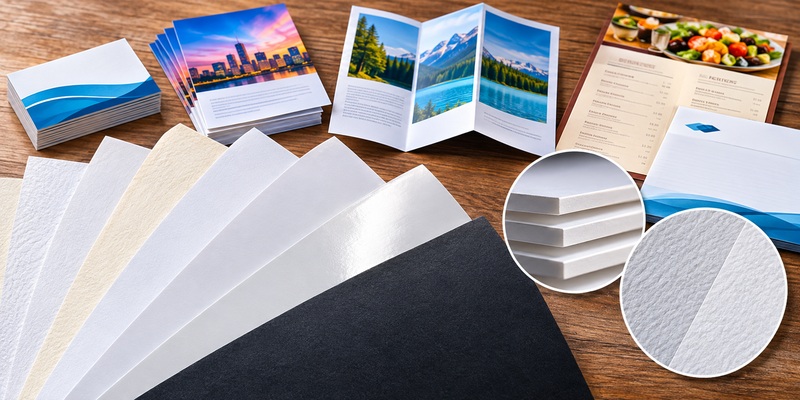
Choosing the right paper stock means balancing appearance, thickness, coating, opacity, durability, and cost against how the finished piece will actually be used. Heavier or more expensive paper is not automatically better. The best stock supports the design, performs well during handling, works with the required finishing, and fits the customer's budget.
For print shops, designers, and resellers, paper selection is also a production decision. It influences how colors appear, how a printed piece feels, whether it folds comfortably, and which finishing options are available.
What Is Paper Stock in Commercial Printing?
Paper stock refers to the paper or paperboard selected for a printed product.
Commercial printing stocks vary in several important characteristics:
- Coating: Whether the paper has a treated printing surface.
- Basis weight: The weight of a specified quantity of paper, measured using the applicable paper category.
- Caliper: The physical thickness of the sheet.
- Brightness and shade: How the paper reflects light and its underlying color.
- Opacity: How effectively the paper prevents printing on the opposite side from showing through.
- Surface texture: How smooth or textured the paper feels.
- Stiffness: How strongly the sheet resists bending.
These properties work together. Two papers of similar thickness may have different stiffness, while papers with the same stated weight can feel noticeably different.
That is why choosing stock based on a single number, such as 100 lb or 16 pt, can produce unexpected results.
How to Choose Paper Stock for Printing
Start with the finished product rather than the paper specification.
A business card needs enough stiffness to feel substantial. A folded brochure requires a stock that folds appropriately without excessive bulk. A restaurant menu may need protection against repeated handling, while letterhead should remain suitable for writing or office printing.
Six characteristics help narrow the choices.
1. Coating: How Should the Surface Look and Feel?
Coated papers have a treated surface that generally supports sharper image reproduction and more saturated-looking colors.
Uncoated papers have a more absorbent surface and typically provide a natural, less reflective appearance.
Neither is universally better.
Coated stocks often work well for image-heavy marketing materials, while uncoated stocks are frequently preferred for stationery, forms, and writing applications.
Remember that the coating manufactured into a paper is different from a finishing treatment applied after printing. UV coating and lamination are separate considerations.
Related guides: Coated vs. Uncoated Paper.
2. Weight and Thickness: How Substantial Should It Feel?
Paper thickness influences how substantial a printed product feels and how it handles.
A thicker sheet generally provides more substance, but stiffness also depends on the paper's composition and construction.
Consider the application:
- A promotional flyer may benefit from flexibility and economical distribution.
- A business card generally needs a thicker, more rigid stock.
- A folded brochure requires a balance between substance and foldability.
- A presentation cover may need greater stiffness than its interior pages.
Extra thickness can increase bulk, affect folding, and influence mailing or shipping costs.
Related guides: Text Stock vs. Cover Stock and 14pt vs. 16pt Business Cards.
3. Brightness and Shade: How Will Paper Affect Color?
Brightness describes how strongly paper reflects blue light under standardized measurement conditions. Shade refers to its overall visual color, such as cool white, warm white, or cream.
They are related but different properties.
A bright, cool-white sheet can create a crisp appearance for photographs and graphics. Warmer whites may suit traditional stationery or understated branding.
Because printing inks interact visually with the underlying paper, identical CMYK artwork may appear different on different stocks.
For projects with strict brand-color expectations, evaluate the intended stock with an appropriate proof rather than relying exclusively on a screen preview.
4. Opacity: Will Printing Show Through?
Opacity measures how effectively paper blocks light.
Lower-opacity stocks may allow printing on the reverse side to become visible, especially with dark graphics or heavy ink coverage.
This matters for double-sided flyers, brochures, booklet interiors, and stationery.
Higher opacity can improve readability and reduce distracting show-through. However, thickness alone does not guarantee opacity. Paper formulation, coating, and construction also influence the result.
Inspect an actual printed sample when show-through is a concern.
5. Texture and Feel: What Impression Should the Paper Create?
Paper communicates quality through touch as well as appearance.
Smooth coated stocks can emphasize polished graphics. Uncoated sheets often create a softer, more tactile presentation. Specialty textures may reinforce a particular brand identity.
Texture also affects printing behavior. Rough or heavily textured surfaces can reproduce fine details and solid ink coverage differently from smooth stocks.
For resellers, the goal is not simply to choose a paper that feels premium. It is to choose one that feels appropriate for the product and its intended audience.
6. Ink Coverage and Handling: How Will the Product Be Used?
Paper selection should account for both the artwork and the finished product's environment.
Heavy ink coverage can behave differently across coated and uncoated stocks. Dark solids may appear less uniform on certain textured surfaces, and printed colors may appear less saturated on absorbent papers.
Handling matters just as much.
A promotional handout distributed once has different requirements from a restaurant menu handled repeatedly throughout the day.
Where additional surface protection is needed, evaluate compatible coatings or laminations rather than assuming thicker paper alone will solve the problem.
Related guides: UV Coating vs. Lamination.
Understanding Paper Weight: lb, pt, and gsm
Commercial printers commonly describe paper using pounds (lb), points (pt), and grams per square meter (gsm).
These measurements describe different properties and are not universally interchangeable.
| Measurement | What It Describes | Important Distinction |
|---|---|---|
| lb | Basis weight | Depends on the paper category and its standard basis-sheet size. |
| pt | Physical thickness | One point equals 0.001 inch. |
| gsm | Mass per unit area | Grams per square meter, regardless of sheet dimensions. |
Why 100 lb Paper Does Not Always Mean the Same Thing
In the United States, basis weight is calculated using the weight of 500 sheets at a standardized basis size.
Different paper categories use different basis-sheet dimensions.
Consequently, 100 lb text paper and 100 lb cover paper do not have the same mass per unit area or necessarily the same thickness and stiffness.
Even within one paper category, two stocks with identical basis weights can have different calipers because of their construction.
What Does 14pt or 16pt Mean?
Point measurements describe physical thickness.
- 14 pt = 0.014 inch
- 16 pt = 0.016 inch
A 16pt stock is nominally thicker than a 14pt stock, but thickness alone does not determine stiffness, surface quality, or suitability for a particular product.
Can You Convert lb to gsm or pt?
Basis weight can be converted to gsm when the paper category and its standard basis-sheet dimensions are known.
However, there is no universal conversion from lb or gsm to pt.
Thickness depends on the paper's density and construction.
Practical rule: When comparing unfamiliar stocks, examine manufacturer specifications or physical samples rather than relying on a generic weight conversion chart.
Which Paper Stock Is Best for Different Print Products?
The best starting point is the product's purpose, expected handling, and desired appearance.
| Product | Practical Starting Point | What to Prioritize |
|---|---|---|
| Business cards | Sturdy cover or card stock | Thickness, stiffness, texture, finish |
| Flyers | Text-weight or lighter cover stock | Distribution, image quality, cost |
| Brochures | Foldable text or suitable cover stock | Foldability, opacity, ink coverage |
| Menus | Stock appropriate to handling frequency | Surface protection, cleanability, stiffness |
| Letterhead | Uncoated writing-compatible stock | Writing performance, office-printer compatibility |
| Postcards | Sturdy cover or card stock | Rigidity, mailing requirements, writable areas |
These are general recommendations, not guarantees of stock availability.
ND4C ordering note: Available paper stocks vary significantly by product. Buyers should review the stock choices offered for the specific product rather than assume every catalog stock is available across all product categories.
Business Cards
Business cards are handled closely, so thickness, surface feel, and finishing are particularly noticeable.
A substantial stock can create a stronger physical impression, but heavier is not always better.
Consider whether the customer wants a polished coated surface, a natural uncoated feel, or a distinctive laminated finish.
Related guides: 14pt vs. 16pt Business Cards.
Flyers
Flyers are frequently distributed in volume, making material cost and handling important.
A lighter stock may suit large-scale handouts, while a more substantial sheet may be appropriate for promotional pieces intended to be retained.
For image-heavy designs, consider how the paper surface affects photographs and saturated colors.
Heavier stocks can also increase the total shipping weight of large quantities.
Brochures
Brochures introduce folding considerations that do not apply to flat sheets.
A heavier stock may feel substantial when unfolded but become bulky or difficult to fold cleanly.
Some stock and fold combinations require scoring to reduce cracking or improve folding performance.
Choose the stock alongside the fold configuration rather than treating them as independent decisions.
Related guides: How to Set Up Files for Folding.
Menus
Menu stock selection depends heavily on the intended use.
A disposable takeout menu has different requirements from a dine-in menu handled repeatedly.
For frequently handled menus, consider whether an available protective finish is appropriate.
Heavier paper may improve stiffness, but it does not automatically make a menu resistant to spills, staining, or repeated cleaning.
Stationery and Letterhead
Stationery typically prioritizes writing performance, appearance, and compatibility with office equipment.
Uncoated paper is often practical because it generally accepts handwriting more readily than heavily coated surfaces.
For letterhead that will be run through an office printer, confirm the compatibility of the specific stock and any preprinted treatments with the equipment.
Paper suitable for commercial printing is not necessarily suitable for every desktop laser or inkjet printer.
How Paper Stock Affects Finishing Options
Paper selection and finishing cannot always be treated as separate decisions.
The available finish may determine which stock can be used, and the chosen stock may restrict the available finishing options.
Coatings and Laminations
Surface treatments can change gloss, texture, handling characteristics, and resistance to surface wear.
At ND4C, finishing availability is product-specific. Certain premium finishes are tied to particular stock specifications.
For example:
- Silk lamination is available on designated 16pt stock.
- Soft-touch finishing is available on designated 18pt stock.
- Spot UV and foil are available only with specific compatible stock and finish combinations, including qualifying silk-laminated and soft-touch products.
These examples do not mean that every product offered on those stocks supports every finishing option. Customers should verify the available combinations in the individual product's ordering specifications.
A finish should be chosen for its visual or functional purpose, not simply because it is marketed as premium.
Folding and Scoring
Paper thickness, grain direction, coating, and ink coverage can influence folding quality.
Heavier stocks and designs with substantial ink coverage across fold lines may require additional attention.
Scoring can improve fold performance for some stocks, but requirements depend on the product, paper, and production process.
Spot UV and Foil
Spot UV and foil can create distinctive decorative effects, but they are not universally compatible with every paper stock or surface treatment.
These processes may depend on a particular base stock, lamination, or finishing sequence.
For resellers, this means stock selection should happen alongside the desired decorative treatment.
If a customer specifically wants spot UV or foil, first identify the compatible product and finishing options, then choose among the available stocks.
Does Paper Stock Affect Digital and Offset Printing?
Yes. Paper characteristics and stock availability can influence both digital and offset production.
Both processes can produce professional results on suitable materials, but compatibility depends on the equipment, inks, coatings, and production workflow.
The printing method can also affect job economics, particularly when comparing short runs with larger quantities.
Standard stocks may offer advantages through established production workflows and purchasing arrangements.
ND4C uses gang-run offset production for compatible work, which can improve production efficiency when multiple jobs share suitable specifications.
Related guides: Digital vs. Offset Printing and Gang-Run Printing Explained.
How Paper Stock Affects Printing Costs
Paper cost is only one part of the finished printing price.
Total cost can also depend on:
- Stock availability and purchasing requirements
- Finished dimensions and sheet utilization
- Order quantity
- Printing method
- Coatings, laminations, folding, and decorative finishing
- Shipping weight and packaging requirements
Thicker or specialty papers may carry higher material costs, but exact price differences depend on the product and production arrangement.
For resellers, the best strategy is to identify the customer's priorities before comparing prices.
If economical distribution is the primary goal, a suitable standard stock may be sufficient.
If tactile presentation is central to the project, a more distinctive stock or finish may justify additional expense.
Standard vs. Custom Paper Choices
Standard catalog stock options are generally the most practical starting point.
They are already associated with defined product specifications and compatible production workflows.
Unusual paper requirements may need sourcing, technical review, or separate pricing.
ND4C offers custom estimates for projects outside its standard catalog specifications. Buyers should confirm feasibility before promising a nonstandard paper or finishing combination.
Why Paper Samples Matter Before Ordering
Paper specifications describe measurable properties, but they cannot fully communicate how a stock looks and feels.
Physical samples help evaluate thickness, stiffness, surface texture, shade, and finish.
They are especially useful when comparing similar-looking paper options or presenting alternatives to a customer.
ND4C sample availability: ND4C offers physical sample packs that allow print buyers and resellers to examine print materials firsthand.
What Should You Evaluate in a Paper Sample?
Examine the sample in the context of the intended product:
- Does the thickness feel appropriate?
- Is the surface smooth, textured, glossy, or matte?
- Does the paper have the desired shade?
- Does the printed image look appropriate for the design?
- Is the stock sufficiently opaque?
- Does the material feel suitable for the expected handling?
A small, flat sample cannot fully predict how a folded brochure will behave.
Similarly, an unprinted paper swatch cannot demonstrate the appearance of heavy CMYK ink coverage.
When color consistency is critical, a printed proof on the intended stock is more informative than a generic paper swatch.
ND4C offers printed proofs on request, generally using the final production method and stock.
Common Paper Stock Selection Mistakes
Choosing Paper by Weight Alone
A 100 lb specification does not fully describe thickness, stiffness, or surface feel.
Compare the paper category, caliper, finish, and intended application.
Assuming Thicker Paper Is Always Better
Excessive thickness can make folding, handling, or mailing less practical.
Choose enough substance for the intended purpose without unnecessary bulk.
Ignoring Opacity
Double-sided designs can suffer from distracting show-through when the paper has insufficient opacity.
Evaluate opacity when printing heavily on both sides.
Selecting Paper Without Checking Finishing Compatibility
Not every stock supports every finish.
At ND4C, options such as silk lamination, soft-touch finishing, spot UV, and foil are restricted to compatible product and stock combinations.
Verify the product specifications before committing to a particular combination.
Assuming Heavier Paper Provides Surface Protection
A heavier stock may be stiffer, but it is not automatically resistant to moisture, staining, or repeated handling.
Consider compatible protective finishes where the application requires them.
Relying Entirely on Screen Previews
Monitors cannot reproduce paper texture, stiffness, or physical shade.
They also cannot fully predict how CMYK inks will appear on a particular paper.
Use physical samples or appropriate proofs when those characteristics matter.
Assuming Every Stock Is Available for Every Product
Stock availability varies by product.
A paper or finish offered for one product may not be offered for another, even when the products appear similar.
Review the exact ordering specifications rather than relying on general assumptions about the printer's capabilities.
Paper Stock Ordering Checklist for Print Resellers
Before placing an order, confirm:
- ☐ The stock suits the product's intended use.
- ☐ Coating and texture support the desired appearance.
- ☐ Thickness and stiffness are appropriate.
- ☐ Opacity is sufficient for two-sided printing.
- ☐ The material works with required folding or scoring.
- ☐ The selected stock supports the desired finish.
- ☐ Paper shade is appropriate for the artwork and brand.
- ☐ The stock and finish combination is available for the specific product.
- ☐ Physical samples or printed proofs have been considered where needed.
- ☐ The selected specifications fit the customer's budget.
For ND4C orders, follow the chosen product's template and file specifications. Submitted print PDFs should use CMYK, with the standard 0.125-inch bleed where applicable.
Frequently Asked Questions About Printing Paper
What is the best all-purpose paper stock for printing?
There is no single best stock for every product. The right choice depends on whether the project prioritizes flexibility, stiffness, writing compatibility, image quality, or surface durability.
Is 100 lb paper thicker than 80 lb paper?
Within the same paper category, higher basis weight often corresponds to greater thickness, but not always. Across different categories, such as text and cover, the numbers are not directly comparable because they use different basis-sheet sizes.
Check actual caliper for a reliable thickness comparison.
Is cardstock the same as cover stock?
The terms overlap in everyday usage. Cardstock generally describes heavier, more substantial paper, while cover stock is a commercial paper category with a defined basis-weight convention.
Neither term guarantees a particular thickness.
Does paper stock affect printed colors?
Yes. Paper shade, coating, absorbency, and texture can influence how printed colors appear.
The same CMYK artwork may look different on two stocks.
Should I choose coated or uncoated paper?
Choose based on how the product will be used. Coated paper often works well for detailed images and polished marketing materials, while uncoated paper is frequently preferred for writing applications and natural surface texture.
Is heavier paper always more expensive?
No. Heavier stocks may increase material or shipping costs, but total pricing depends on availability, quantity, production method, and finishing requirements.
Can every paper stock be used with spot UV or foil?
No. These finishing methods require compatible materials and production processes.
At ND4C, spot UV and foil are available only with specified stock and finishing combinations. Check the product's ordering options before selecting a stock.
How can I tell whether paper will feel premium?
Physical samples provide the most useful comparison.
Thickness, stiffness, texture, shade, and finishing all contribute to perceived quality. ND4C offers physical sample packs to help buyers assess these characteristics.
Final Recommendation: Choose Paper for the Finished Product
The best paper stock is one that performs well in the customer's actual application.
Start with the product's purpose, then evaluate thickness, coating, opacity, color appearance, texture, and finishing requirements.
For trade-print buyers, the final decision should also account for product-specific stock availability. A desirable material is only a practical choice when it is compatible with the intended product and production process.
Physical samples and printed proofs can help turn paper specifications into realistic expectations, reducing unnecessary expense, production complications, and customer disappointment.
ND4C is a wholesale trade printer with more than two decades of industry experience. Our Print Playbook guides draw on firsthand expertise across prepress, production, customer support, design, and print technology to help retail printers and print resellers make better production decisions.