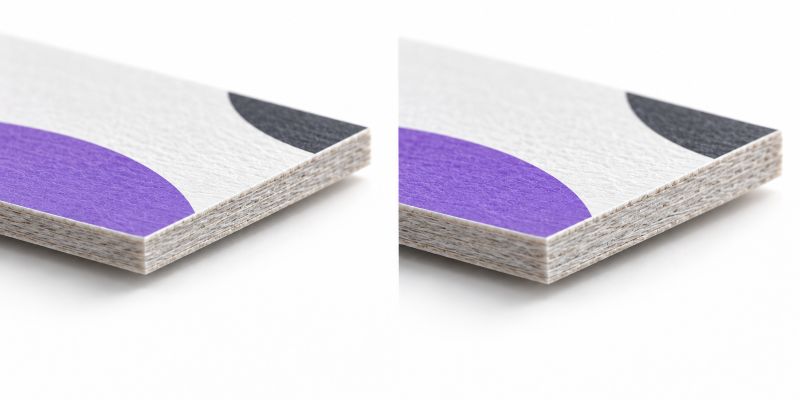
16pt business cards are slightly thicker and generally feel firmer than 14pt cards, but the difference is modest. Both suit professional business cards. The right choice depends on the desired feel, stock construction, finish, available production options, and total price.
Quick Comparison: 14pt vs 16pt Business Cards
| Feature | 14pt Cardstock | 16pt Cardstock |
|---|---|---|
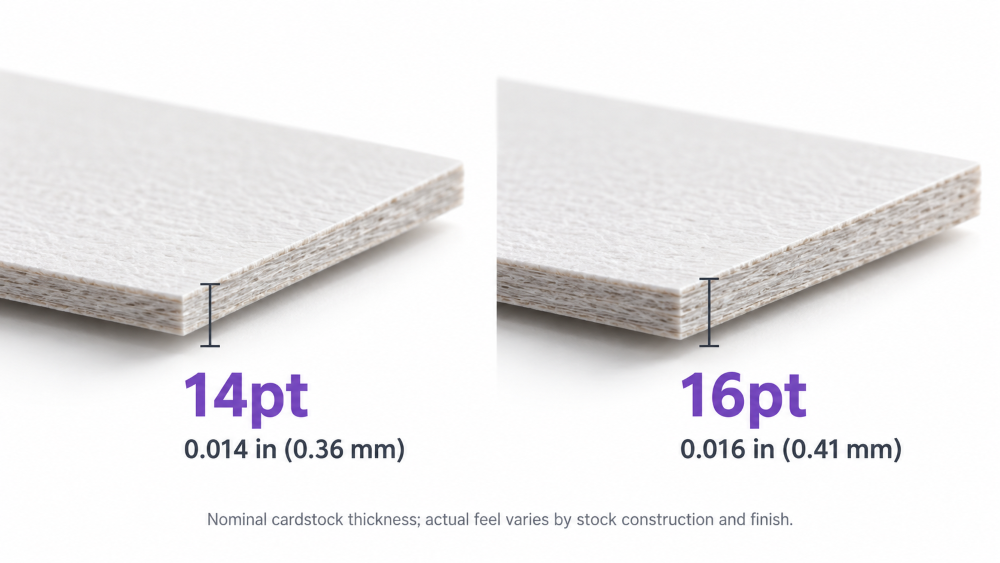
| Nominal thickness | 0.014 in. (0.36 mm) | 0.016 in. (0.41 mm) |
| Feel | Substantial, moderately flexible | Slightly thicker and generally firmer |
| Rigidity | Suitable for standard cards | Generally greater with comparable construction |
| Perceived quality | Professional | Can feel more substantial |
| Finishing | Depends on product and stock | Depends on product and stock |
| Pricing | Depends on stock type, coating, quantity, method, and other specifications; thickness alone does not determine cost. | |
Bottom line: Choose 14pt when added thickness is unnecessary. Consider 16pt when a slightly firmer, more substantial feel supports the intended presentation.
What Is the Difference Between 14pt and 16pt Cardstock?
The numbers describe nominal paper thickness, also called caliper. One caliper point equals one-thousandth of an inch. A 14pt sheet is nominally 0.014 inches thick; a 16pt sheet is 0.016 inches thick. The difference is 0.002 inches, or approximately 0.05 mm.
The difference can be felt when comparing similar physical samples, but actual finished thickness and feel depend on stock construction, coating, and lamination. Two papers with the same point rating need not feel identical.
Key Differences That Matter
Thickness and Feel
14pt cardstock offers a substantial professional feel. 16pt adds a modest increase that some recipients perceive as firmer or more premium. For clients who care about the tactile difference, compare samples of the actual selected stocks.
Rigidity and Flexibility
With comparable paper construction, 16pt generally resists bending more than 14pt. However, fiber composition, density, coatings, and laminated films affect rigidity. The point rating alone does not establish durability or predict every stock's bending behavior.
Perceived Quality
Thickness can reinforce a premium impression, but it is only one characteristic. Typography, layout, print reproduction, color consistency, surface feel, and finishing also matter. A well-executed 14pt card can make a better impression than a less considered 16pt card.
Coatings and Finishing Compatibility
Both thicknesses can support various finishes, but options depend on the exact product configuration. ND4C offers 14pt and 16pt C2S business card options, as well as configurations including 14pt uncoated, 16pt matte, and 16pt silk-laminated products. These are not interchangeable comparisons of thickness alone. Lamination adds a film and can change total thickness and handling characteristics.
For surface-specific guidance, see Coated vs Uncoated Paper and Gloss vs Matte Paper.
When to Choose 14pt
- Everyday professional networking and standard company cards.
- Frequent or high-volume distribution where extra thickness is unnecessary.
- Orders where a suitable 14pt configuration provides the desired appearance and total value.
14pt is a professional card stock—not inherently a budget-looking or inferior result.
When to Choose 16pt
- Brands seeking a slightly firmer, more substantial hand feel.
- Client-facing cards where tactile presentation is important.
- Minimalist designs where the physical stock is a noticeable part of the experience.
Expect a modest difference, not a dramatic transformation. Evaluate the particular stock and finish together.
Does 16pt Cost More?
Not necessarily. A thicker stock does not automatically cost more. Stock type, coating or lamination, quantity, production method, standard versus custom specifications, and turnaround requirements can all affect the price.
ND4C uses gang-run production to make many standard-format jobs efficiently. Standard stock and size combinations may benefit from that shared production model. Different stock types can nevertheless have different costs at the same nominal thickness or quantity. Requirements outside standard ordering options may require a custom estimate.
Reseller tip: Compare complete configurations at the intended quantity. A specialty 14pt stock should not automatically be assumed less expensive than a standard 16pt coated stock.
Practical Examples
Frequently Distributed Networking Cards
A service business needs cards for many employees and events. Standard 14pt coated stock may deliver the desired professional result. Compare actual finishes and total prices before upgrading.
Premium Consulting Brand
A boutique firm prioritizes physical presentation. A 16pt stock may complement the design's intended feel, provided samples confirm the benefit and pricing fits the job.
Specialty-Finish Business Card
A designer wants a particular laminated feel. The deciding factor is the available finished product configuration rather than the nominal cardstock thickness alone.
How to Decide
- Decide whether a firmer feel matters to the customer.
- Confirm which finishes are available with each exact stock.
- Compare physical samples if tactile quality is central.
- Price equivalent quantities and complete configurations.
- Consider the intended distribution, branding, and delivery needs.
Key Takeaways
16pt is nominally 0.002 inches thicker than 14pt. Comparable 16pt stock generally feels firmer, but paper construction and finishing affect the result. Both can look professional; neither is universally the better value.
Frequently Asked Questions
Is 16pt noticeably thicker than 14pt?
Yes, especially side by side, but the difference is modest.
Is 16pt higher quality?
Not inherently. Thickness is one characteristic alongside construction, printing, design, and finishing.
Are 14pt business cards too thin?
No. 14pt is suitable for conventional professional business cards.
Are 16pt cards more durable?
Comparable 16pt stock generally has greater bending resistance, but overall durability also depends on material, finish, and handling.
Does 16pt bend less easily?
Usually when compared with otherwise similar paper construction; different stocks can behave differently.
Do 16pt cards look better?
Not necessarily. Thickness primarily changes feel; visual quality depends heavily on artwork and finishing.
Can 14pt have a premium finish?
Yes, where the particular product offers that finishing option.
Is 16pt always more expensive?
No. Pricing depends on the full stock and production specification.
What does C2S mean?
Coated two sides. It does not, by itself, define gloss level or the full finished appearance.
Does lamination increase thickness?
Yes. The applied film adds to the finished card thickness and can change the surface feel.
Which is better for luxury cards?
Either can work. Select based on the complete intended appearance and tactile presentation.
Should resellers upgrade every order to 16pt?
No. Recommend it only when added thickness meaningfully supports the job's goals and budget.
Related Print Playbook Guides
Ready to compare options? Review the actual ND4C business card configurations and prices at your intended quantity. For specifications outside standard options, request a custom estimate.