PRINT PLAYBOOK GUIDE - PRINT COMPARISONS
Part of Series: Print Comparisons
Coated vs Uncoated Paper: Differences & Best Uses
 ND4C Print Experts
Quick Answer: What Is the Difference Between Coated and Uncoated Paper?
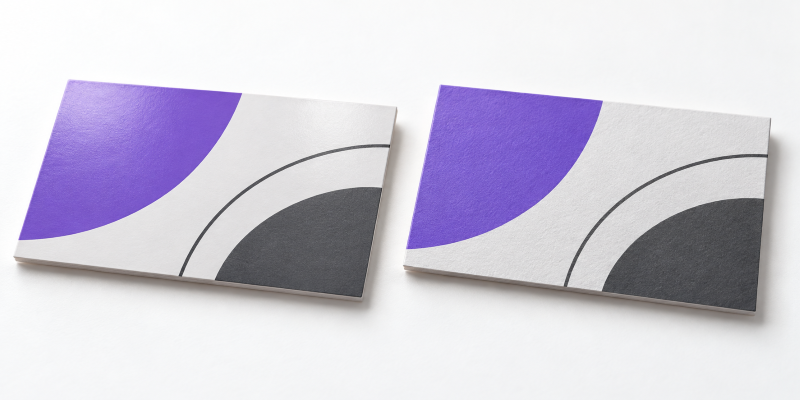
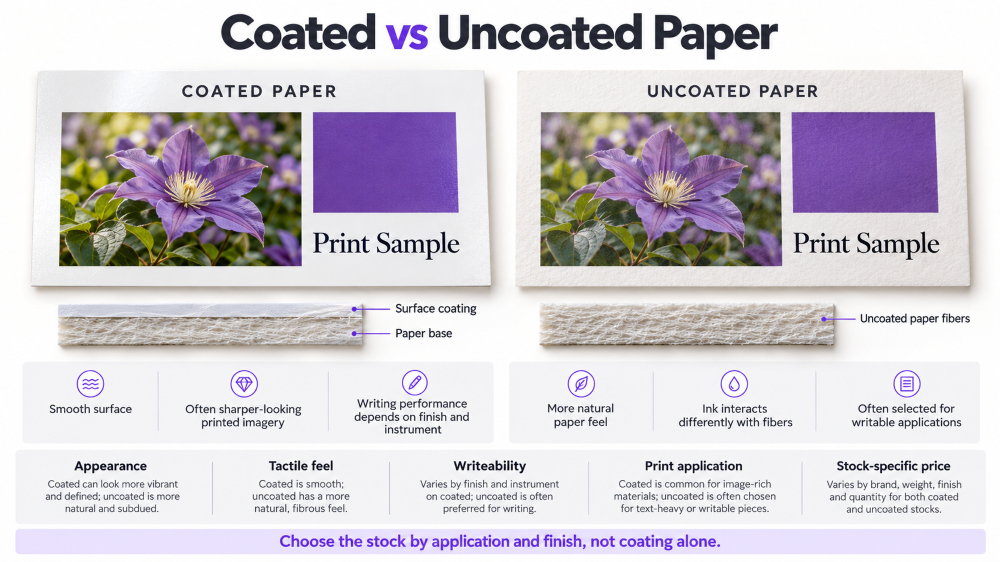
Coated paper has a surface treatment that creates a smoother, more uniform printing surface, generally producing sharper images, stronger contrast, and richer printed colors. Uncoated paper has a more natural, absorbent surface that offers a softer appearance and is often better suited for writing.
Choose coated paper when image reproduction, color vibrancy, and visual detail are priorities. Choose uncoated paper when writing suitability, natural texture, or a subdued visual style matters more.
Neither is universally better. The right choice depends on how the printed piece should look, feel, and function.
Quick Comparison: Coated vs Uncoated Paper
| Feature | Coated Paper | Uncoated Paper |
|---|---|---|
| Surface | Smoother, more uniform | More porous, natural feel |
| Ink appearance | Typically richer colors and stronger contrast | Typically softer, more subdued colors |
| Fine image detail | Generally sharper reproduction | More dependent on paper grade and printing process |
| Writing suitability | Varies; some pens and inks may smear or dry slowly | Generally better for handwriting |
| Texture | Smooth; available in gloss, silk, dull, and matte finishes | Natural, smooth, vellum, or textured |
| Light reflection | Depends on coating; can be glossy or low-glare | Generally low-glare |
| Typical applications | Postcards, brochures, catalogs, promotional materials | Notepads, letterhead, forms, stationery |
| Cost | Depends on stock, quantity, and production | Depends on stock, quantity, and production |
The comparison describes typical commercial printing behavior. Individual paper grades, ink systems, and printing methods can produce different results.
Understanding the Two Paper Types
What Is Coated Paper?
Coated paper receives a surface coating, commonly made with mineral pigments and binders, that improves surface uniformity and controls how printing ink interacts with the sheet.
The coating creates a smoother printing surface and generally supports more precise ink reproduction.
Coated stocks are available in several finishes:
- Gloss: A reflective surface that emphasizes image contrast and color vibrancy.
- Matte: A lower-sheen finish with a more subdued appearance.
- Dull or silk: Finishes generally offering a softer sheen than gloss.
Important distinction: A matte-coated sheet is still coated paper. A lack of visible shine does not mean the paper is uncoated.
Coated paper is commonly used for full-color brochures, postcards, marketing materials, catalogs, and business cards.
What Is Uncoated Paper?
Uncoated paper does not have the same pigment-based surface coating used to create the typical coated printing surface. Its surface generally exposes more of the paper's natural fiber characteristics.
Uncoated stocks range from relatively smooth commercial sheets to textured specialty papers. Their absorbency and surface characteristics typically produce a softer printed appearance.
Uncoated paper is commonly selected for letterhead, envelopes, notepads, stationery, forms, and printed materials designed to be written on.
Uncoated does not necessarily mean rough, inexpensive, or low quality. Premium uncoated stocks can be exceptionally smooth and are often selected specifically for their appearance and tactile characteristics.
Key Differences That Affect Print Quality and Usability
1. Color Vibrancy and Image Reproduction
One of the most noticeable differences is how ink appears after printing.
Coated paper generally produces:
- More saturated colors
- Stronger image contrast
- Better definition in fine photographic details
- More consistent reproduction across solid color areas
Uncoated paper typically produces:
- Softer color reproduction
- Lower apparent saturation
- A more natural or muted appearance
- Less separation in some fine details and darker image areas
Surface absorption, smoothness, ink behavior, and the way light reflects from the printed sheet all contribute to these differences.
Practical implication: The same CMYK artwork can look noticeably different on coated and uncoated stocks. If a customer changes paper types after approving a design, the reseller should explain that the finished colors may change even when the artwork remains identical.
2. Writing and Stamping
Uncoated paper is generally the better starting point when customers need to write directly on printed materials.
Common applications include appointment cards, note cards, forms, worksheets, letterhead, notepads, and documents requiring signatures.
Many ballpoint pens, pencils, and stamps work well on suitable uncoated stocks because of their surface characteristics. Coated paper can also accept writing, but performance depends on the specific coating, pen, and ink. Some writing instruments may skip, smear, or require additional drying time on coated surfaces.
For materials that must be written on or stamped, test the intended instrument on the actual stock.
3. Appearance and Brand Presentation
Coated and uncoated papers communicate different visual styles.
| Coated paper | Uncoated paper |
|---|---|
| A polished, image-focused appearance. Particularly effective for detailed photography, colorful graphics, and high-contrast marketing materials. | A softer, understated appearance. Often selected for natural textures, minimalist designs, and traditional business stationery. |
These are aesthetic tendencies, not fixed rules. A premium uncoated paper can convey sophistication, while a matte-coated stock can provide a restrained appearance without sacrificing as much image definition.
The design, typography, paper shade, and printing method all influence the final impression.
4. Handling, Folding, and Durability
Neither paper type is automatically more durable. Handling performance depends on paper grade and thickness, grain direction, ink coverage and curing, scoring and folding requirements, protective coatings or lamination, and expected handling conditions.
Coated papers can show scuffing, fingerprints, or surface marking, depending on their finish and the printed image. Uncoated stocks can also scuff, absorb moisture, or show handling marks.
Heavy ink coverage across folds can introduce cracking concerns, particularly with heavier stocks. Proper scoring and grain direction can help, but the actual paper and job specifications determine the appropriate finishing approach.
For frequently handled pieces, evaluate the complete paper-and-finishing combination rather than assuming one paper category offers better protection.
When Should You Choose Coated Paper?
Coated paper is generally a strong choice when the primary purpose of the printed piece is visual communication.
- Full-color promotional postcards
- Photography-heavy brochures
- Product catalogs
- Marketing flyers
- Image-focused business cards
- Printed pieces with substantial color coverage
Coated paper is especially useful when the design depends on vivid color, high contrast, or fine photographic detail. However, if the piece requires handwriting or frequent stamping, verify that the selected surface is suitable.
When Should You Choose Uncoated Paper?
Uncoated paper is often a better fit when the printed piece has a practical writing function or requires a natural visual style.
- Letterhead and business correspondence
- Notepads and forms
- Appointment or message cards
- Traditional stationery
- Minimalist business cards
- Printed pieces intended for handwritten personalization
Uncoated paper can also be an intentional design choice for promotional materials. A brochure featuring restrained colors, simple typography, and natural photography may look excellent on uncoated paper.
The goal is to match the material to the design—not simply maximize color saturation.
Cost and Wholesale Production Considerations
Coated paper is not automatically more expensive than uncoated paper, and uncoated paper is not automatically the economical alternative.
Wholesale printing costs depend on the specific stock and how efficiently the job fits the printer's production system.
| Cost factor | Why it matters |
|---|---|
| Stock grade | Different coated and uncoated grades have different material costs |
| Stock weight | Thickness or basis weight affects material requirements but does not determine price alone |
| Quantity | Production efficiencies and quantity breaks vary by job |
| Standard availability | Common catalog stocks may fit established production workflows |
| Printing method | Offset and digital processes have different requirements and economics |
| Finishing | Folding, scoring, coating, and other operations can affect total cost |
| Custom specifications | Nonstandard stock or size requirements may require separate production arrangements |
ND4C Production Perspective
In ND4C's wholesale production experience, paper selection can materially change pricing even when the finished size, nominal stock weight, and quantity remain identical.
For example, switching between 14pt coated two-sided (C2S) and 14pt uncoated business card stocks can produce a meaningful difference in the quoted price.
This does not establish that one category is consistently more expensive. Pricing depends on the particular products and production conditions.
ND4C uses standardized product options and gang-run production to achieve efficiencies where jobs can be grouped with compatible work.
A stock outside the standard catalog may require a custom estimate. That does not make it an unsuitable choice, but it should be considered when comparing production options.
For resellers: Compare actual quotes for the intended finished size, stock, quantity, and finishing specifications. Do not estimate the price difference based solely on whether the sheet is coated or uncoated.
For a detailed explanation of broader cost drivers, see What Determines Wholesale Print Pricing?
Practical Wholesale Printing Examples
Example 1: A Full-Color Real Estate Postcard
A print reseller is producing postcards with professional property photographs.
Recommended starting point: Coated paper. A coated stock will generally preserve more contrast and detail in the images. It is a practical option when photographic presentation is central to the piece.
If the postcards include a handwritten message area, the reseller should also evaluate writing suitability or an appropriate alternative stock.
Example 2: Business Cards for a Design Studio
A designer wants understated business cards with minimalist typography and a natural paper feel.
Recommended starting point: Uncoated paper. The tactile quality and softer appearance may support the desired brand presentation. If the design includes large saturated color areas, the customer should review printed samples before committing to the stock.
Example 3: Appointment Reminder Cards
A print shop is producing cards on which employees will write appointment dates and times.
Recommended starting point: Uncoated paper. Writing performance is an important functional requirement. A printed design may look attractive on either stock, but the ability to write cleanly and consistently should drive the decision.
Example 4: A Corporate Sales Brochure
An agency is preparing a brochure with product photographs, charts, and substantial color coverage.
Recommended starting point: Coated paper. Coated stock generally supports sharper color reproduction and detailed imagery. If the client prefers a low-sheen appearance, a suitable matte- or dull-coated option may provide a useful middle ground.
Key Takeaways
- Choose coated paper when photographic detail, color saturation, and visual contrast are priorities.
- Choose uncoated paper when handwriting, natural texture, or a softer visual appearance is important.
- Matte-coated paper and uncoated paper are not the same material.
- Paper selection changes printed color appearance, even when the artwork is unchanged.
- Neither category guarantees better durability or lower cost.
- Compare real stock specifications, printed samples, and production quotes before making a final recommendation.
The most reliable approach is to start with the finished piece's purpose, then select the paper that best supports its appearance, function, and production requirements.
Frequently Asked Questions
Is coated paper better than uncoated paper?
Not universally. Coated paper generally offers stronger image detail and color saturation, while uncoated paper is often better for writing and natural texture. The best choice depends on the application.
Which paper is better for business cards?
Coated business cards are often preferred for full-color imagery and polished graphics. Uncoated cards are useful for understated designs and cards that may need handwritten notes.
Is uncoated paper cheaper than coated paper?
Not necessarily. Material grades, stock availability, print quantity, and production methods affect pricing. Compare actual quotations for equivalent job specifications.
Can you print full-color photographs on uncoated paper?
Yes. Uncoated paper can reproduce full-color photography, although colors and fine details typically appear softer than on comparable coated stock. The printing method and paper grade influence the result.
Is matte paper coated or uncoated?
Either is possible. Matte describes a low-sheen appearance, not whether the sheet has a coating. Matte-coated and uncoated papers have different surface characteristics.
Can you write on coated paper?
Sometimes. Writing performance varies by coating and writing instrument. Some pens or stamps may smear or dry slowly, so testing is recommended.
Does uncoated paper absorb more ink?
Conventional uncoated stocks generally allow greater ink penetration than coated stocks. However, ink absorption and printed appearance vary with the paper, ink system, and printing process.
Is coated paper waterproof?
No. Standard coated paper should not be considered waterproof. Its surface coating is primarily intended to modify printing and appearance characteristics, not guarantee protection from water.
Does coated paper last longer than uncoated paper?
Not necessarily. Longevity depends on the paper grade, printing process, protective finishing, environmental exposure, and handling conditions.
Can the same artwork be printed on both paper types?
Yes, although color reproduction may differ. For color-sensitive work, production-appropriate color management and representative printed samples help establish realistic expectations.
Which paper is better for folded brochures?
Both can work well. Select the stock based on the desired image quality, thickness, folding requirements, and finish. Heavier stocks or demanding folds may require scoring or other production considerations.
Are uncoated papers always rough?
No. Uncoated papers range from relatively smooth sheets to strongly textured specialty grades.
Is matte-coated paper better for writing than gloss-coated paper?
It may be, but a low-sheen finish does not guarantee good writing performance. Test the intended pen or stamp on the exact stock.
Can uncoated printing produce vibrant colors?
Yes, particularly with certain paper grades and ink technologies. Nevertheless, conventional uncoated printing generally has different color reproduction characteristics from comparable coated printing.
How should resellers help customers choose?
Ask whether the piece prioritizes photography, handwriting, tactile appearance, finishing requirements, or budget. Compare suitable stock samples and obtain production quotes for the actual specifications.
Related Print Playbook Guides
- Gloss vs Matte Paper — Understand surface sheen and visual presentation within coated paper choices.
- C1S vs C2S Paper — Compare one-sided and two-sided coating requirements.
- What Determines Wholesale Print Pricing? — Learn how stock and other production variables affect quotes.
- How to Choose a Printing Method — Understand the production-method decision after selecting suitable materials.
- File Setup Guide — Prepare artwork and manage print reproduction expectations.
- Wholesale Business Card Guide — Apply paper and finishing decisions to business card orders.
ND4C is a wholesale trade printer with more than two decades of industry experience. Our Print Playbook guides draw on firsthand expertise across prepress, production, customer support, design, and print technology to help retail printers and print resellers make better production decisions.