PRINT PLAYBOOK GUIDE - PRINT COMPARISONS
Part of Series: Print Comparisons
Text Stock vs Cover Stock
 ND4C Print Experts
Quick Answer
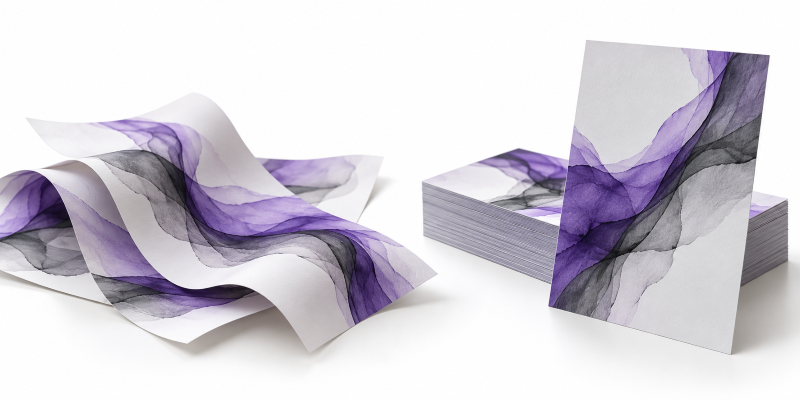
Text stock is generally lighter and more flexible than cover stock, making it useful for brochures, flyers, booklet interiors, and other materials that need to fold or turn easily. Cover stock is generally heavier and stiffer, making it appropriate for business cards, postcards, invitations, and booklet covers.
Text and cover are paper classifications—not exact thickness measurements. Basis weight, caliper, stiffness, coating, and construction all influence how a finished piece performs.
Text Stock vs Cover Stock: Quick Comparison
| Feature | Text Stock | Cover Stock |
|---|---|---|
| General characteristics | Flexible, lighter-weight paper | Heavier, more rigid paper or paperboard |
| Typical products | Flyers, brochures, booklet interiors, inserts | Business cards, postcards, covers, invitations |
| Handling | Generally bends and folds more readily | Generally resists bending |
| Common US basis weights | 60 lb, 70 lb, 80 lb, 100 lb text | 65 lb, 80 lb, 100 lb, 110 lb cover |
| Folding | Often suitable for multi-panel folds | May require scoring, depending on the stock and design |
| Surface | Coated and uncoated options | Coated and uncoated options |
| Cost | Depends on the specific stock and production | Depends on the specific stock and production |
| Primary selection factor | Flexibility and comfortable handling | Rigidity and substantial presentation |
These are general classifications. Actual specifications and compatible options vary by manufacturer, printer, and product.
What Is Text-Weight Paper?
Text Stock: Definition
Text stock is a category of printing paper typically used for flexible sheets and interior pages. It is available in different weights, coatings, and finishes for commercial printing applications.
Text stock is generally thinner, lighter, and easier to bend than typical cover stock. It suits printed materials that must fold, stack, mail, or turn as pages without substantial rigidity.
Common applications include:
- Brochures and folded promotional materials
- Flyers and informational handouts
- Booklet and catalog interior pages
- Reports, manuals, and publications
- Loose-leaf inserts and marketing materials
A lighter text stock may suit a booklet with many pages, while a heavier text stock may provide a more substantial feel for a premium brochure. Text weight does not mean low quality: premium text papers can have refined surfaces, excellent opacity, and substantial weight.
What Is Cover-Weight Paper?
Cover Stock: Definition
Cover stock is a heavier paper classification commonly used where greater stiffness, shape retention, or a substantial feel matters. It includes many papers marketed as cardstock, in various constructions and finishes.
Cover stock typically resists bending more than text stock. Its applications include:
- Business cards and postcards
- Greeting cards and invitations
- Booklet and catalog covers
- Presentation folders
- Hang tags and promotional cards
A lighter cover stock may work for a folded invitation, while a much heavier cover stock may suit a rigid business card. The appropriate choice depends on the desired feel, finishing, and product specifications.
Why 80 lb Text Is Not the Same as 80 lb Cover
The US basis-weight system describes the weight of 500 sheets at a standard reference size assigned to a paper category. The reference sizes are different for text and cover stock.
| Paper Classification | Standard Basis Sheet Size |
|---|---|
| Text/book paper | 25 × 38 inches |
| Cover paper | 20 × 26 inches |
Because these reference sizes differ, an 80 lb text stock and an 80 lb cover stock do not have the same mass per square foot. An 80 lb cover stock has considerably more mass per unit area than an 80 lb text stock. Pound values should therefore never be compared without identifying the paper classification.
What Is GSM?
GSM means grams per square meter. It uses the same unit area for every paper classification and is helpful when comparing paper mass across text and cover categories.
| Paper Specification | Approximate GSM |
|---|---|
| 60 lb text | 89 gsm |
| 80 lb text | 118 gsm |
| 100 lb text | 148 gsm |
| 80 lb cover | 216 gsm |
| 100 lb cover | 270 gsm |
These are nominal conversions, not guaranteed measurements of a particular manufactured stock. GSM is useful for comparing mass, but it still does not measure thickness or stiffness.
Paper Weight, Caliper, and Stiffness Are Different
- Basis weight or GSM: How much paper mass there is per unit area.
- Caliper: The physical thickness of a sheet, often expressed in points (pt) or thousandths of an inch.
- Stiffness: How strongly the sheet resists bending, affected by its thickness, fiber properties, construction, and grain direction.
Important distinction: A 14pt cover stock describes nominal thickness, while an 80 lb cover stock describes basis weight. They are not directly interchangeable. Two sheets with the same GSM can have different calipers, and sheets with similar calipers can feel different when bent.
For a focused comparison of business-card thickness, see 14pt vs 16pt Business Cards.
Key Differences That Affect the Finished Piece
1. Flexibility and Handling
Text stock is usually the better starting point when a printed piece must bend, fold, or turn easily. Flexible interior pages help a booklet remain comfortable to read and prevent unnecessary bulk. Cover stock is more appropriate when an individual piece needs to hold its shape, as with a business card.
2. Folding and Scoring
Both text and cover stock can be folded. Text stock generally folds more readily; heavier cover stock may benefit from scoring, which creates a controlled fold line. Scoring can improve folding but cannot guarantee that cracking will never occur.
Whether scoring is appropriate depends on the paper's thickness, stiffness, coating, grain direction, ink coverage at the fold, fold configuration, and finishing equipment. Folding parallel to the grain generally gives a more favorable result, especially with heavier stock.
When preparing artwork for folded products, use the printer's product-specific templates to confirm correct panel dimensions, fold locations, and other file requirements. ND4C provides free templates for its products.
3. Rigidity and Durability
Cover stock generally provides greater resistance to bending and deformation. It is useful for standalone pieces that are handled often. But higher paper weight does not automatically guarantee better moisture resistance, abrasion resistance, tear resistance, or surface durability. Those properties also depend on the material and finish.
4. Perceived Quality
A firm card can signal a premium product, but premium presentation does not always call for maximum thickness. An appropriately selected text stock may allow a brochure to fold cleanly and feel refined. Very rigid stock may be inconvenient for multi-folded or multi-page products.
When to Choose Each Stock
Choose Text Stock When:
- The piece has several folds or many interior pages.
- Flexibility and comfortable page turning matter.
- Lower bulk is desirable.
- The primary purpose is to communicate information in a document-like format.
Choose Cover Stock When:
- The piece needs to retain its shape.
- A firmer, more substantial presentation is important.
- It will be handled individually or frequently.
- Its application benefits from additional rigidity.
Cost and Production Considerations
Material Selection
Paper cost depends on the specific stock, not only its classification or thickness. Coating, fiber composition, finish, brand, sourcing, and availability can change material prices. A specialty text stock may cost more than a conventional cover stock.
Production Compatibility
Stocks must suit the printing and finishing operations. Heavier materials may need additional folding or scoring considerations, and some stock choices may not be compatible with particular equipment or catalog configurations.
Standard Stock Options and Gang-Run Efficiency
ND4C produces many catalog products using gang-run production, where compatible jobs share production resources. Choosing an available standard stock lets a job follow the applicable established production option. Specifications outside the catalog, including a nonstandard stock, can require a custom estimate.
Neither classification is automatically less expensive. Compare the full specifications and actual quoted prices rather than assuming that lighter paper is always cheaper.
Mailing and Shipping
Paper mass, dimensions, page count, and finished thickness can affect packaging, shipping, and postage. A heavier paper choice multiplied across many booklet pages can significantly change the finished piece's mass. For mail campaigns, verify the applicable postal size, thickness, weight, and preparation rules.
Practical Wholesale Printing Examples
Tri-Fold Marketing Brochure
Recommended starting point: text stock. Flexibility generally makes it practical for three-panel folding and handling. A suitable cover stock may still work if a more substantial feel is desired, but fold requirements deserve review.
Premium Business Card
Recommended starting point: cover stock. Its stiffness supports a firm presentation. Select the actual caliper, coating, and finish according to the desired feel and available production specifications.
Multi-Page Product Booklet
Recommended starting point: text stock for interior pages, with cover stock considered for a separate cover. This balances flexibility inside with the option of a firmer exterior.
At ND4C, customers select cover and interior stocks separately for applicable booklet products. This lets resellers balance interior-page flexibility with the desired cover stiffness. Available combinations depend on the booklet product and binding method.
Folded Invitation
Recommended starting point: a suitable cover stock. It can provide a substantial feel, but weight and fold behavior matter. A lighter cover stock with appropriate scoring may be a better fit than an extremely heavy stock.
Key Takeaways
- Text stock emphasizes flexibility for brochures, flyers, interiors, and folded or multi-page pieces.
- Cover stock emphasizes stiffness for cards, covers, invitations, and individually handled pieces.
- Paper categories are not thickness measurements. Basis weight, GSM, caliper, and stiffness mean different things.
- Folding requires planning. Heavier stocks may need scoring or other finishing considerations.
- Select for the finished job. Handling, feel, compatibility, and total production cost all matter.
Frequently Asked Questions
Is text stock the same as regular printer paper?
Not necessarily. Commercial text stocks range from relatively light sheets to substantial premium papers with different coatings, opacity, and finishes.
Is cover stock the same as cardstock?
The terms often overlap. Cover is a recognized paper classification; cardstock is a broader term for heavier, stiffer paper. Compare exact specifications.
Is 100 lb text thicker than 80 lb cover?
Not necessarily, and commonly not. The nominal weights are approximately 148 gsm and 216 gsm, respectively. Actual thickness requires caliper specifications.
Can text stock be used for postcards?
Yes, if it meets the desired handling, rigidity, mailing, and printer requirements. Cover stock is generally the more conventional starting point.
Can cover stock be used for brochures?
Yes. It may provide a more substantial feel, but multi-panel folding and scoring requirements should be reviewed.
Which is better for booklet interior pages?
Text stock is generally preferred because it provides flexibility and helps manage bulk. Page count, opacity, binding, and presentation affect the weight choice.
Should a booklet cover always use cover stock?
No. Some booklets have self-covers using the same stock as the interior; others have a separate, heavier cover. Choose according to construction and available product options.
Is cover stock always thicker than text stock?
No. The broad categories can overlap. Compare the manufacturer’s caliper specifications for exact products.
Can both text and cover stocks be coated?
Yes. Both categories can have coated or uncoated surfaces. Surface treatment is separate from text-versus-cover classification.
Does heavier paper always cost more?
No. Material type, coating, availability, quantity, and the production workflow affect actual pricing.
Does heavier cover stock always need scoring?
No. The need depends on the specific sheet, grain, fold, print coverage, and finishing equipment. There is no universal weight threshold.
Is GSM better than pounds for comparing paper?
GSM provides a consistent mass-per-area comparison across categories. It does not replace caliper or stiffness measurements.
What stock should I use for a premium brochure?
Consider heavier text stock for flexibility and clean folding. Consider appropriate cover stock for greater firmness, provided the fold configuration works.
Can I request a specific text or cover stock from ND4C?
ND4C offers standard stock selections that vary by product. If the required stock is outside those catalog options, request a custom estimate.
Related Print Playbook Guides
- 14pt vs 16pt Business Cards — Compare business-card thickness and feel.
- Coated vs Uncoated Paper — Compare surfaces and printing characteristics.
- Standard vs Custom Print Sizes — Understand sizing and production efficiency.
- How Paper Size Affects Print Cost — Understand sheet utilization.
- What Determines Wholesale Print Pricing? — Explore materials, finishing, and total job cost.
- File Setup Guide — Prepare print-ready artwork.
ND4C is a wholesale trade printer with more than two decades of industry experience. Our Print Playbook guides draw on firsthand expertise across prepress, production, customer support, design, and print technology to help retail printers and print resellers make better production decisions.