PRINT PLAYBOOK GUIDE - PRINT COMPARISONS
Part of Series: Print Comparisons
Gloss vs Matte Paper: What's the Difference and Which Should You Choose?
 ND4C Print Experts
Quick Answer
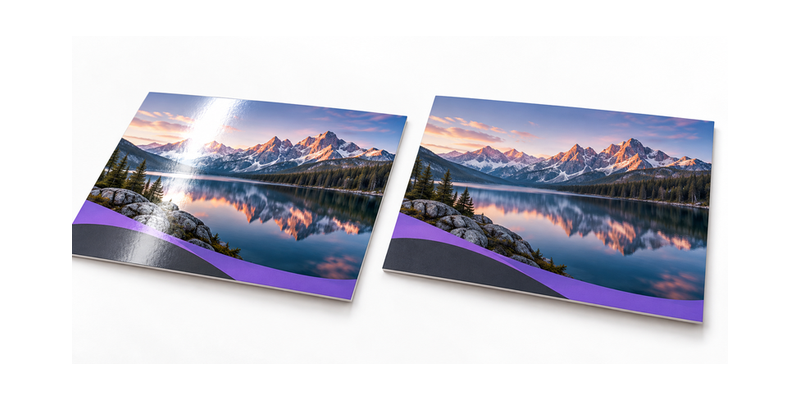
Gloss paper has a reflective surface that often gives photographs and colors a more vivid, high-contrast appearance. Matte paper has a low-sheen surface that reduces glare and creates a subdued presentation. Choose gloss when photographic impact is the priority; choose matte when readability and low reflection matter more. Both can deliver professional print quality.
Gloss vs Matte Paper: Quick Comparison
| Consideration | Gloss | Matte |
|---|---|---|
| Surface | Shiny and reflective | Low sheen, reduced glare |
| Image appearance | Often appears more vivid and contrast-rich | Often appears softer and more restrained |
| Readability | Reflections can interfere under some lighting | Usually easier to view under directional lighting |
| Handling marks | Fingerprints can be conspicuous | May conceal fingerprints, but can still mark or scuff |
| Typical applications | Photo-heavy promotional pieces, product imagery | Text-heavy brochures, corporate materials |
| Durability and writing | Both depend on the specific stock and any applied finish; neither is automatically writable or more durable. | |
Important distinction
Matte does not mean uncoated. Gloss and matte describe appearance and reflectivity. A matte-looking sheet may be coated, and an applied post-print coating or laminate can also alter sheen. For paper construction, see Coated vs Uncoated Paper; for applied protection, see UV Coating vs Lamination.
Understanding Gloss and Matte Paper
What is gloss paper?
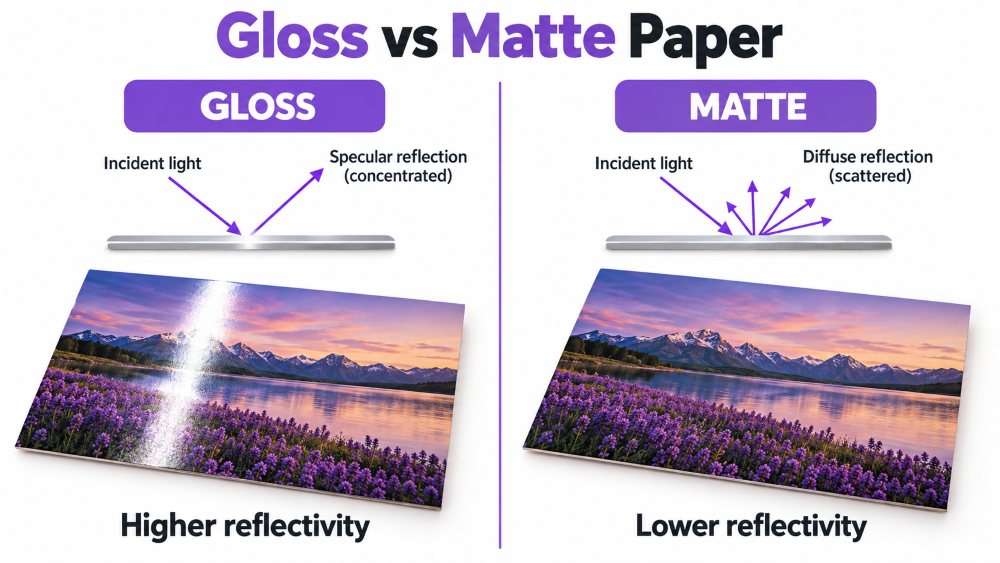
Gloss-coated paper has a relatively reflective surface. Its sheen can make dark areas appear richer and colorful imagery more visually intense. It is a strong starting point for product photography, promotional pieces, and designs intended to catch attention. Reflections can be distracting in bright or unpredictable lighting.
What is matte paper?
Matte paper has a low-sheen surface. A matte-coated stock can still be smooth and reproduce detailed images well; it is not necessarily rough or absorbent like an uncoated sheet. Matte is useful for restrained branding, editorial layouts, and longer passages of text.
Five Differences That Affect Print Selection
1. Glare and viewing conditions
Gloss surfaces return more light in distinct reflections. These highlights can be attractive, but they can also obscure portions of a piece under overhead lights or near windows. Matte surfaces diffuse more light and usually reduce glare. For reading materials viewed in varied environments, matte is often the safer starting point.
2. Photographs and perceived color
Gloss often creates the impression of greater saturation, depth, and contrast, especially in photography. Matte typically produces a more restrained appearance. That does not mean matte prints inaccurately or lacks detail: the final result depends on the paper grade, ink, press, and color management. Judge samples under the lighting in which the finished product will be used.
3. Readability
Matte can make paragraphs, charts, and technical information more comfortable to read by reducing reflections. Gloss can still carry readable text when type size, contrast, and layout are well designed. The important variable is the actual viewing environment, not a universal rule against gloss.
4. Fingerprints and handling
Fingerprints and oils may be more noticeable on reflective gloss surfaces. Some matte surfaces hide ordinary handling marks, but other matte finishes can show scuffs, rubbing, or oily fingerprints. Neither sheen guarantees protection. For heavily handled pieces, test the exact material and finish.
5. Visual impression
Gloss can reinforce bold, energetic photography and promotional graphics. Matte can complement restrained typography, subtle color palettes, and professional communications. Neither is inherently more premium; the better choice is the one that supports the design and the audience.
When to Choose Each
| Application | Starting point | Reason |
|---|---|---|
| Photography-heavy promotional flyer | Gloss | Emphasizes visual contrast and imagery |
| Corporate capabilities brochure | Matte | Restrained appearance with reduced glare |
| Product catalog | Either | Balance photography against extended reading |
| Text-heavy informational brochure | Matte | More comfortable viewing under varied light |
| Business cards | Either | Brand appearance and handling matter most |
| Promotional postcards | Either | Choose for image style, lighting, and available options |
Cost and Wholesale Production Considerations
Neither gloss nor matte is automatically less expensive. Price depends on the particular stock, quantity, availability, production method, and finishing requirements. Two papers of comparable nominal thickness can carry materially different costs.
ND4C's catalog presents standard product and stock choices designed around compatible production specifications. Available surface and finishing options depend on the selected product and stock. A specification outside the standard selections may require a custom estimate.
Compare the full job rather than sheen alone: stock, printed quantity, front-and-back finishing, turnaround, expected handling, and delivery requirements. Gang-run production can make compatible standard configurations efficient, but it does not establish a universal price advantage for one surface.
Paper surface versus applied finish
Gloss and matte may describe the stock's appearance or a treatment applied after printing. UV coatings, other coatings, and laminates are distinct processes with different production and protection characteristics. A matte-coated sheet does not necessarily have matte lamination; a gloss-coated sheet does not inherently have UV gloss. See UV Coating vs Lamination for the finishing decision.
Practical Example: Two Brochures
Retail product brochure: A reseller's customer supplies vibrant product photography and short descriptions. Gloss may enhance the desired photographic impact.
Professional services brochure: Another customer uses restrained colors and substantial explanatory text. Matte may reinforce the visual style and reduce glare during reading.
Both are legitimate choices on quality coated stocks. The intended use, rather than an assumed quality ranking, determines the recommendation.
Key Takeaways
- Choose gloss when vivid-looking photography and strong visual impact take priority.
- Choose matte when low glare and comfortable reading matter more.
- Both coated surfaces can support high-quality image reproduction.
- Matte is not automatically uncoated, writable, fingerprint-resistant, or more durable.
- Compare actual product and finishing options, and use physical samples for important appearance decisions.
Frequently Asked Questions
Is gloss or matte paper better for printing?
Neither is universally better. Gloss often suits image-driven pieces, while matte works well for low-glare or text-heavy applications.
Does gloss make colors look brighter?
Gloss can make colors appear more saturated and contrast-rich. Actual reproduction depends on stock, inks, production, and color management.
Is matte better for reading?
Often, because its lower reflectivity reduces distracting surface glare.
Is matte the same as uncoated?
No. Matte is a description of sheen. Paper may be matte-coated or uncoated, with different printing behavior.
Does matte paper absorb more ink than gloss paper?
Not necessarily. Ink holdout depends on the exact paper formulation and printing process, not its sheen alone.
Which is better for photographs?
Gloss is a common choice for vivid image impact. Matte can better suit restrained photography or glare-sensitive viewing.
Which shows more fingerprints?
Gloss can reveal fingerprints more conspicuously, but some matte stocks or laminates also show oils and handling marks.
Is matte more expensive?
Not inherently. Compare the actual stock, quantity, production, and finishing combination.
Can you write on matte paper?
Sometimes. Matte-coated stock may still resist certain pens; test the actual material and writing instrument.
Can gloss paper be laminated?
Yes, when the product and process are compatible. Lamination adds a separate treatment and may change the appearance.
Is matte more professional?
No. Matte often creates an understated appearance, but gloss can be equally appropriate and professional.
Which is better for business cards?
Either may work. Match the surface to the brand, likely handling, and available stock and finish combinations.
Does matte last longer?
Not simply because it is matte. Durability depends on paper construction, finishing, and exposure.
Can identical artwork look different on the two surfaces?
Yes. Reflectivity can change perceived contrast and depth, even when the printed design is the same.
Should resellers offer both?
When supported by the catalog, both choices help match customers' aesthetic and practical requirements.
Related Guides
ND4C is a wholesale trade printer with more than two decades of industry experience. Our Print Playbook guides draw on firsthand expertise across prepress, production, customer support, design, and print technology to help retail printers and print resellers make better production decisions.