PRINT PLAYBOOK GUIDE - PRINT COMPARISONS
Part of Series: Print Comparisons
Sheetfed vs Web Printing
 ND4C Print Experts
Quick Answer: What Is the Difference Between Sheetfed and Web Printing?
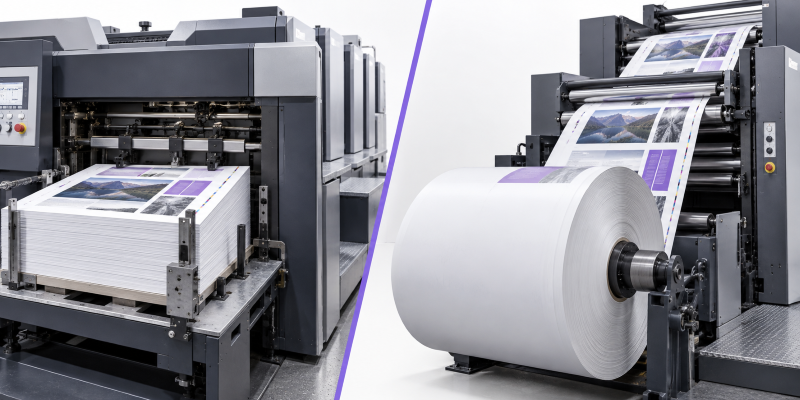
Sheetfed printing feeds individual, precut sheets of paper through a printing press, while web printing feeds a continuous roll of paper through the press. Sheetfed presses generally offer greater flexibility for paper selection, job sizes, and production quantities. Web presses are designed for continuous, high-speed production and can deliver lower unit costs on sufficiently large print runs. The better choice depends on quantity, paper specifications, finished size, finishing requirements, and total production cost.
The essential difference is how paper enters the press, not necessarily how the image is printed. Both sheetfed and web presses can use offset lithography, and both feeding formats also exist in digital printing.
What Are Sheetfed and Web Printing?
30-Word Definition
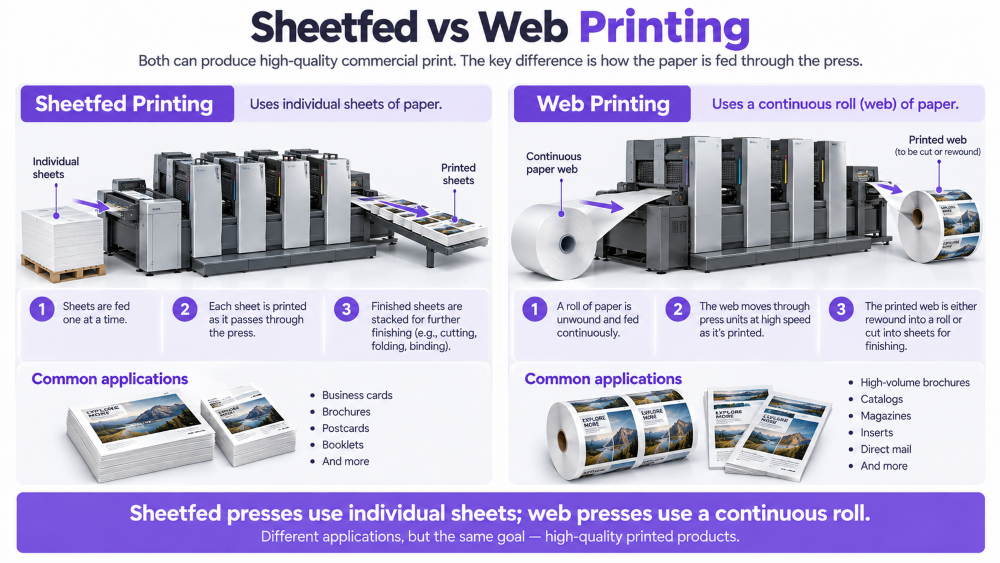
Sheetfed printing uses individual sheets of paper, while web printing uses continuous paper rolls. Both support commercial production, but differ in paper handling, production efficiency, flexibility, and typical run lengths.
In commercial offset printing, sheetfed presses take paper from a stack, print it, and deliver the printed sheets for subsequent production steps. Web presses draw paper from large rolls, maintaining a continuous flow through printing and, depending on the press configuration, drying, cutting, or folding equipment.
These different feeding systems influence production economics. Sheetfed equipment accommodates a wide range of commercial projects, while web equipment is particularly effective when a consistent product must be produced in substantial volume.
For print resellers, understanding the difference helps determine which production capabilities to investigate when quoting brochures, catalogs, direct mail, and other printed materials.
How Does Sheetfed Printing Work?
Sheetfed printing moves separate sheets of paper through the press rather than printing from a continuous roll.
Typical sheetfed offset production process
- Paper preparation: The required paper stock is supplied in sheets sized for the press and job layout.
- Press setup: Printing plates, inks, registration, and other settings are prepared for the job.
- Sheet feeding: The feeder separates and delivers individual sheets into the press.
- Image transfer: Ink is transferred to the sheets through the offset printing units.
- Sheet delivery: Printed sheets are collected in a delivery pile. Depending on equipment, both sides may be printed in one pass or through separate passes.
- Finishing: Sheets are cut, folded, coated, bound, or otherwise finished according to the product.
Why sheetfed printing is flexible
Sheetfed presses can accommodate a broad variety of coated and uncoated papers, cover-weight stocks, and specialty materials, subject to the press’s technical specifications.
Because each job can be produced using an appropriate sheet size, stock, and finishing workflow, sheetfed production is well suited to many commercial printing applications.
This flexibility is particularly useful for products such as business cards, postcards, brochures, pocket folders, and printed covers.
Direct Answer: Is sheetfed printing better for smaller print runs?
Sheetfed offset is generally more practical than conventional web offset for shorter or medium-sized commercial runs, particularly when paper selection, format flexibility, or specialized finishing matters. For very small quantities, sheetfed digital printing may be more economical than either offset approach.
How Does Web Printing Work?
Web printing draws paper continuously from a large roll through the press, allowing high-volume production without feeding individual sheets.
Typical web offset production process
- Roll preparation: A large paper roll is mounted on the press’s unwinding system.
- Web feeding: Paper unwinds and travels continuously through the press under controlled tension.
- Press setup: Printing plates, ink delivery, registration, and web-handling equipment are adjusted.
- Continuous printing: The moving paper passes through printing units, often configured to print both sides.
- Ink setting or drying: The printed web passes through the appropriate drying system, depending on the inks, paper, and press technology.
- Inline processing: The web may be slit, cut, folded, or otherwise processed before the finished or partially finished output is delivered.
Web printing is particularly useful for publications, advertising inserts, direct mail, and other products produced in large quantities with consistent specifications.
Heatset vs Coldset Web Offset Printing
Conventional web offset presses commonly use two different ink-setting approaches.
| Method | How it works | Typical applications |
|---|---|---|
| Coldset web offset | Ink sets primarily through absorption into porous paper, without a heatset drying oven. | Newspapers, newsprint inserts, certain uncoated book interiors |
| Heatset web offset | Printed paper passes through a heated dryer, allowing suitable inks to set on coated or uncoated papers. | Magazines, catalogs, advertising inserts, commercial publications |
Heatset printing generally supports coated papers and more demanding commercial color reproduction. Coldset is commonly associated with absorbent, uncoated stocks and high-volume publication work.
These are not the only web-printing technologies. Digital inkjet web presses, for example, also print from continuous rolls but use a different imaging and drying process.
Direct Answer: Why is web printing used for high-volume jobs?
Web presses move paper continuously through high-speed printing and processing equipment. Once the press is properly set up, long runs can spread preparation costs across large quantities while reducing the handling required between production stages.
Sheetfed vs Web Printing: Key Production Differences
| Production factor | Sheetfed printing | Web printing |
|---|---|---|
| Paper feeding | Individual precut sheets | Continuous rolls |
| Typical production scale | Shorter through substantial commercial runs | Especially efficient for sustained, high-volume runs |
| Paper selection | Broad range of sheet stocks and weights | Roll stocks compatible with the press |
| Setup | Job-specific setup and makeready | Can involve substantial setup and web-threading preparation |
| Production speed | High, but sheets are fed individually | Very high continuous output on suitable equipment |
| Unit economics | Often advantageous for smaller or varied commercial work | Often advantageous at sufficiently large quantities |
| Size flexibility | Determined by press-sheet dimensions and imposition | Determined by web width, cutoff, and finishing configuration |
| Finishing | Commonly separate, with some inline options | Inline folding, cutting, and other operations may be integrated |
| Common applications | Business cards, brochures, folders, postcards, book covers | Newspapers, catalogs, magazines, inserts, high-volume direct mail |
| Key limitation | Individual-sheet handling and job setup | High setup commitment and format or stock constraints |
The table describes common commercial offset production arrangements. Specific capabilities vary by equipment, and neither feeding format guarantees a particular quality level, speed, or price.
What Production Factors Affect the Choice?
1. Print quantity and run length
Quantity is one of the most important considerations.
Sheetfed printing can economically handle a wide range of commercial quantities. Web printing becomes especially attractive when long, continuous production runs justify the setup and equipment requirements.
However, there is no universal quantity at which web printing automatically becomes less expensive.
The crossover depends on the specific press, finished product, paper, number of pages or forms, and finishing requirements.
For a deeper explanation of quantity-based cost behavior, see How Quantity and Print Run Length Affect Unit Cost.
2. Paper type and availability
Sheetfed presses are particularly useful when projects require varied paper weights, finishes, and substrates.
Web presses require suitable roll-fed materials. Paper selection is influenced by roll availability, web width, tension requirements, drying method, and equipment limitations.
Specialty paper that works on a sheetfed press may not be available in a compatible roll or may require a different production method.
3. Finished size and layout
Sheetfed jobs are arranged on parent press sheets. The number of finished pieces that fit on each sheet influences paper utilization and trimming waste.
Web jobs must fit the available web width, cutoff, and downstream processing configuration.
A finished size that works efficiently on one press configuration may require additional trimming or create excess waste on another.
4. Printing and color requirements
Both sheetfed offset and appropriately equipped web offset presses can produce high-quality multicolor printing.
Color reproduction depends on press configuration, paper, ink system, drying method, process control, and production conditions.
Sheetfed production is frequently selected for premium commercial pieces requiring specific papers, finishes, or tight production control. Properly configured web production can also deliver excellent commercial color quality.
Web printing should not automatically be considered lower quality than sheetfed printing.
5. Finishing requirements
Finishing can materially influence the preferred production method.
Sheetfed workflows commonly move printed sheets to separate cutting, folding, coating, or binding operations. Web equipment may integrate certain finishing processes directly into the production line.
Inline finishing can improve efficiency for repetitive, high-volume work, but only when the required product and configuration are compatible.
6. Turnaround and production scheduling
A web press can produce very large quantities rapidly once running, but setup, available press capacity, paper procurement, and finishing schedules all affect the actual completion date.
A sheetfed job may move through production more quickly when the run is smaller or its specifications match available equipment.
Direct Answer: Is web printing always faster than sheetfed printing?
Web presses often achieve higher sustained production output, but this does not guarantee faster delivery. Setup, press availability, drying, finishing, and shipping determine the actual turnaround for a finished job.
How Do Sheetfed and Web Printing Affect Cost?
The main economic difference is the relationship between setup requirements and production volume.
Sheetfed cost considerations
Sheetfed offset production generally includes job-specific preparation, press makeready, paper, ink, printing time, and finishing.
For smaller commercial quantities, the ability to run individual jobs efficiently without a large continuous production commitment can make sheetfed equipment an economical choice.
Sheetfed production can also avoid costs associated with forcing unusual materials or finished sizes into an unsuitable web configuration.
Web cost considerations
Web offset production may involve significant preparation, including press setup, web threading, registration adjustment, and startup waste.
Once operating efficiently, continuous printing and potentially integrated processing can reduce manufacturing cost per finished piece on large runs.
However, the cost advantage depends on enough usable production volume to offset the initial preparation and waste.
How costs behave as quantity increases
| Cost consideration | Smaller runs | Very large runs |
|---|---|---|
| Setup allocation | Larger cost per finished piece | Spread across more pieces |
| Startup waste | Can represent a substantial share of production | Often a smaller share of total volume |
| Production efficiency | Flexible setups may be more valuable | Sustained throughput becomes more valuable |
| Paper utilization | Depends on sheet layout | Depends on web width, cutoff, and layout |
| Finishing efficiency | Separate operations may be practical | Integrated operations may offer substantial savings |
Consider a marketing campaign requiring 2,000 brochures compared with a recurring publication requiring 200,000 copies.
The brochure job may be more economically produced through sheetfed production because it does not justify the setup of a conventional high-volume web press.
The publication may benefit from web production because printing and folding can continue efficiently over a much larger volume.
These examples illustrate typical production economics, not fixed quantity thresholds.
Direct Answer: Is web printing cheaper than sheetfed printing?
Web offset printing often offers lower unit costs for sufficiently large, compatible print runs. Sheetfed printing can be more economical for smaller quantities, varied papers, specialized formats, or jobs where web setup and waste outweigh production-speed savings.
Advantages and Limitations
Sheetfed printing
Advantages
- Broad stock selection
- Flexible commercial formats
- Well suited to diverse product specifications
- Practical for many moderate production quantities
- Supports specialized finishing workflows
Limitations
- Individual-sheet feeding can limit sustained throughput
- Separate finishing operations may add handling
- Very large repetitive runs may have higher unit costs
Web printing
Advantages
- High sustained production output
- Efficient for long, repetitive runs
- Potentially lower unit costs at scale
- Can integrate cutting and folding
- Well suited to large publication and direct-mail programs
Limitations
- Setup and startup waste may be substantial
- Roll-stock compatibility is important
- Format and cutoff restrictions can apply
- Often less economical for smaller or highly specialized jobs
How Do You Decide Between Sheetfed and Web Printing?
Start with the finished product and production specifications rather than assuming one type of press is superior.
Production Decision Framework
- Is the job a relatively small commercial print run? Compare sheetfed offset and digital production first. A conventional web offset setup may not be justified.
- Does the job require very large quantities of consistent printed material? Include web offset in the comparison, especially for publications, inserts, and large direct-mail programs.
- Does the customer require a specialty stock, heavy cover material, or unusual finish? Investigate sheetfed options and confirm whether suitable web materials and finishing configurations exist.
- Can the finished dimensions work efficiently with a web press’s width and cutoff? Compare layouts, waste, and finishing requirements before choosing the production method.
- Is the job a recurring publication with consistent specifications? Investigate whether web production can improve long-run manufacturing efficiency.
When another production method may be better
The comparison is not limited to sheetfed offset and web offset.
For very small quantities, variable-data printing, personalized direct mail, or frequent artwork changes, digital production may be a stronger option.
High-volume roll-fed digital inkjet may also compete with offset for some applications, particularly when personalization or versioning is important.
For a broader method-selection framework, see How to Choose a Printing Method.
Common Production Mistakes
Mistake 1: Assuming web printing is always cheaper
Why it matters: A high-speed press can still produce an expensive job when setup, startup waste, or finishing requirements are disproportionate to quantity.
Better approach: Compare complete production costs at the actual requested quantity.
Mistake 2: Choosing a production method before confirming paper
Why it matters: A specified stock may not be suitable or available for the intended press.
Better approach: Confirm material availability and equipment compatibility before committing to a production quote.
Mistake 3: Ignoring finished-size limitations
Why it matters: A poorly matched web width or cutoff can create waste, require additional trimming, or make a job impractical.
Better approach: Evaluate how the finished product fits the available production format.
Mistake 4: Treating all web presses as interchangeable
Why it matters: Heatset, coldset, and digital web presses have different ink systems, drying requirements, substrates, and typical applications.
Better approach: Identify the actual technology and specifications rather than relying only on the term “web printing.”
Mistake 5: Comparing press speed instead of completed-job turnaround
Why it matters: Fast printing does not eliminate setup, procurement, finishing, packing, or shipping time.
Better approach: Compare realistic production schedules through delivery.
Mistake 6: Assuming one press must produce every component
Why it matters: A publication may require different materials or quality specifications for the cover and interior pages.
Better approach: Consider a combined production workflow when different components benefit from different methods.
Production Checklist: Before Requesting a Quote
- ☐ Confirm the required finished quantity and any planned reprints.
- ☐ Specify finished size, page count, and orientation.
- ☐ Identify paper type, weight, coating, and finish.
- ☐ Confirm color requirements for all printed components.
- ☐ Identify folding, trimming, binding, and other finishing needs.
- ☐ Determine whether personalization or variable data is required.
- ☐ Confirm acceptable production and delivery dates.
- ☐ Ask about format restrictions, setup waste, and paper availability when considering web production.
- ☐ Compare total delivered cost rather than press cost alone.
- ☐ Confirm any critical quality or dimensional requirements before approval.
Common Questions About Sheetfed and Web Printing
What is the main difference between sheetfed and web printing?
Sheetfed printing feeds individual sheets of paper through a press, while web printing feeds paper continuously from a roll. This difference affects production efficiency, material selection, job flexibility, and typical run lengths.
Is sheetfed printing the same as offset printing?
No. Sheetfed describes how material enters a press, while offset describes the printing process used to transfer ink. Offset printing can be performed on either sheetfed or web presses.
Is web printing always offset printing?
No. Although conventional web offset is widely used for high-volume commercial printing, digital inkjet and other printing technologies can also use continuous roll-fed systems.
Which method is better for small print runs?
Sheetfed production is generally better suited to smaller commercial quantities than conventional web offset. Very small jobs may be more economical on digital presses, depending on specifications and available equipment.
Which method is best for very large print runs?
Web offset is often advantageous for very large runs of consistent materials, especially publications, newspaper inserts, and direct mail. The choice still depends on paper, format, setup, finishing, and total cost.
Can web printing use coated paper?
Yes. Heatset web offset printing commonly supports suitable coated paper stocks used for magazines, catalogs, and advertising materials. Stock compatibility depends on the press and drying system.
Can sheetfed and web presses both print full color?
Yes. Properly configured sheetfed and web offset presses can both produce full-color CMYK printing. Actual reproduction quality depends on equipment, materials, calibration, and production controls.
Why are newspapers commonly printed on web presses?
Newspapers require large quantities of pages produced quickly, often on lightweight, absorbent paper. Coldset web offset systems are well suited to continuous printing and folding of these publications.
Can the same product be manufactured using both methods?
Yes. Brochures, catalogs, flyers, and other commercial products may be produced using either method when their specifications are compatible. The most economical choice can change with quantity and production configuration.
Does web printing have more paper waste?
Web printing can generate substantial startup waste during press preparation. However, efficient continuous production and suitable layouts may reduce waste per usable piece on long runs. Total waste depends on the job and equipment.
Can a printer use sheetfed and web printing on the same project?
Yes. For example, a large publication might use web printing for interior pages and sheetfed printing for a heavier or specially finished cover. The components can then be assembled during binding.
Is sheetfed or web printing better for custom paper sizes?
Sheetfed printing often provides greater flexibility for varied finished sizes. Web printing must accommodate the equipment’s web width, cutoff, and finishing configuration. A custom size may be economical on either method if the production layout is efficient.
Related Production Guides
These guides extend the sheetfed-versus-web comparison into specific production decisions.
- Offset Printing Explained — Understand the offset image-transfer process shared by conventional sheetfed and web offset presses.
- How Quantity and Print Run Length Affect Unit Cost — Explore how setup, run length, waste, and production volume change the cost per finished piece.
- How Paper Size Affects Print Cost — See how press-sheet utilization, layouts, and material dimensions affect printing economics.
- How to Choose a Printing Method — Evaluate the broader decision between offset, digital, and other production approaches.
- Digital Printing Explained — Understand how digital production handles shorter runs, variable data, and applications where offset setup may be unnecessary.
Related Print Products and Applications
Understanding sheetfed and web production is particularly useful when quoting:
| Product or application | Production consideration |
|---|---|
| Brochures | Quantity, paper weight, fold configuration, and finishing |
| Flyers | Run length, stock choice, and layout efficiency |
| Catalogs | Circulation, page count, paper selection, and binding |
| Direct mail | Quantity, format, personalization, and mailing preparation |
| Publication printing | Recurring volume, paper consumption, and folding requirements |
| Booklet production | Interior stock, cover requirements, page count, and binding |
Explore the relevant products through the ND4C wholesale printing catalog.
Final Next Step
Start with the actual specifications: quantity, finished size, paper, page count, finishing, and delivery requirements. Then compare production options based on their total delivered cost.
For print resellers, the practical objective is not to select the fastest press. It is to select a production workflow that meets the customer’s specifications at an appropriate cost and turnaround.
ND4C is a wholesale trade printer with more than two decades of industry experience. Our Print Playbook guides draw on firsthand expertise across prepress, production, customer support, design, and print technology to help retail printers and print resellers make better production decisions.